
original hero image


Double Materiality Assessment


Overview of Double Materiality Assessment

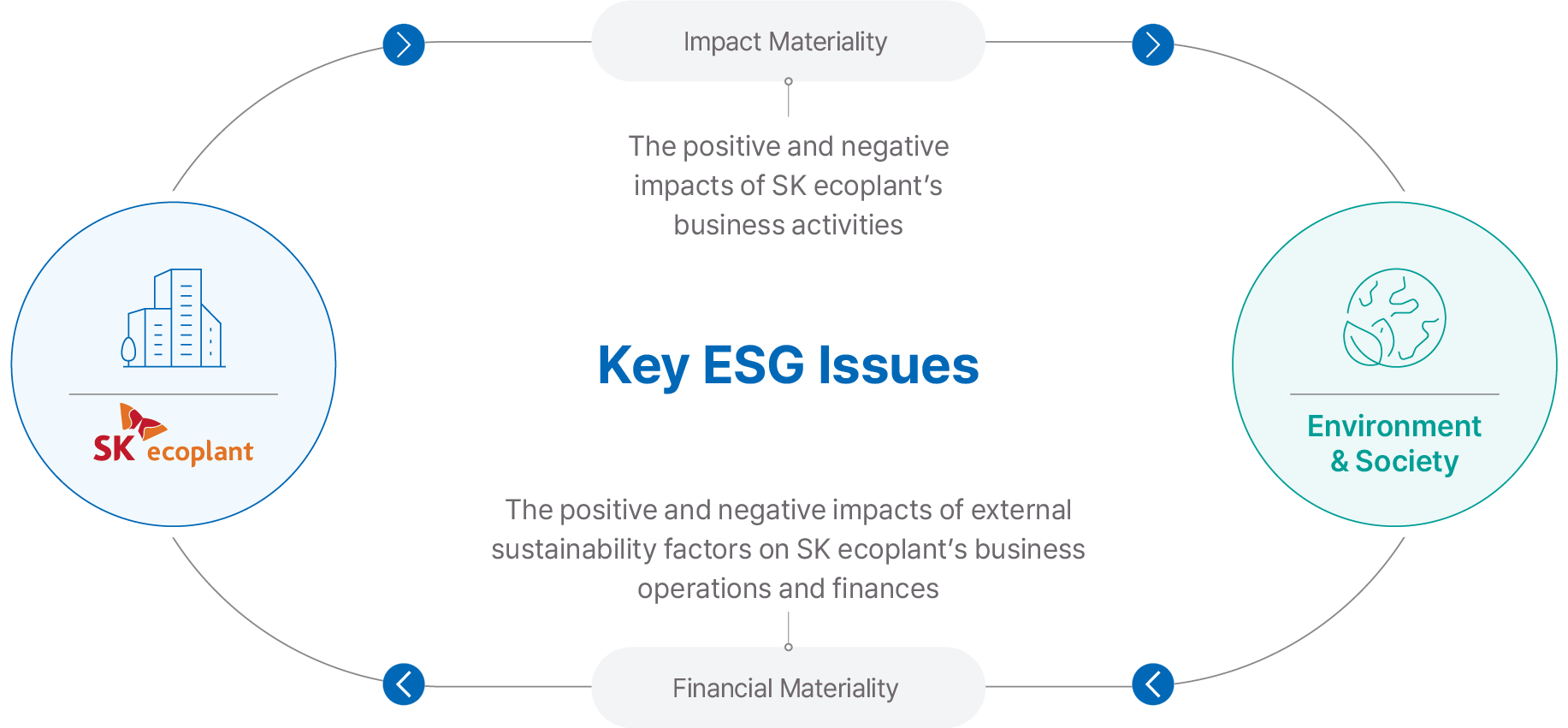
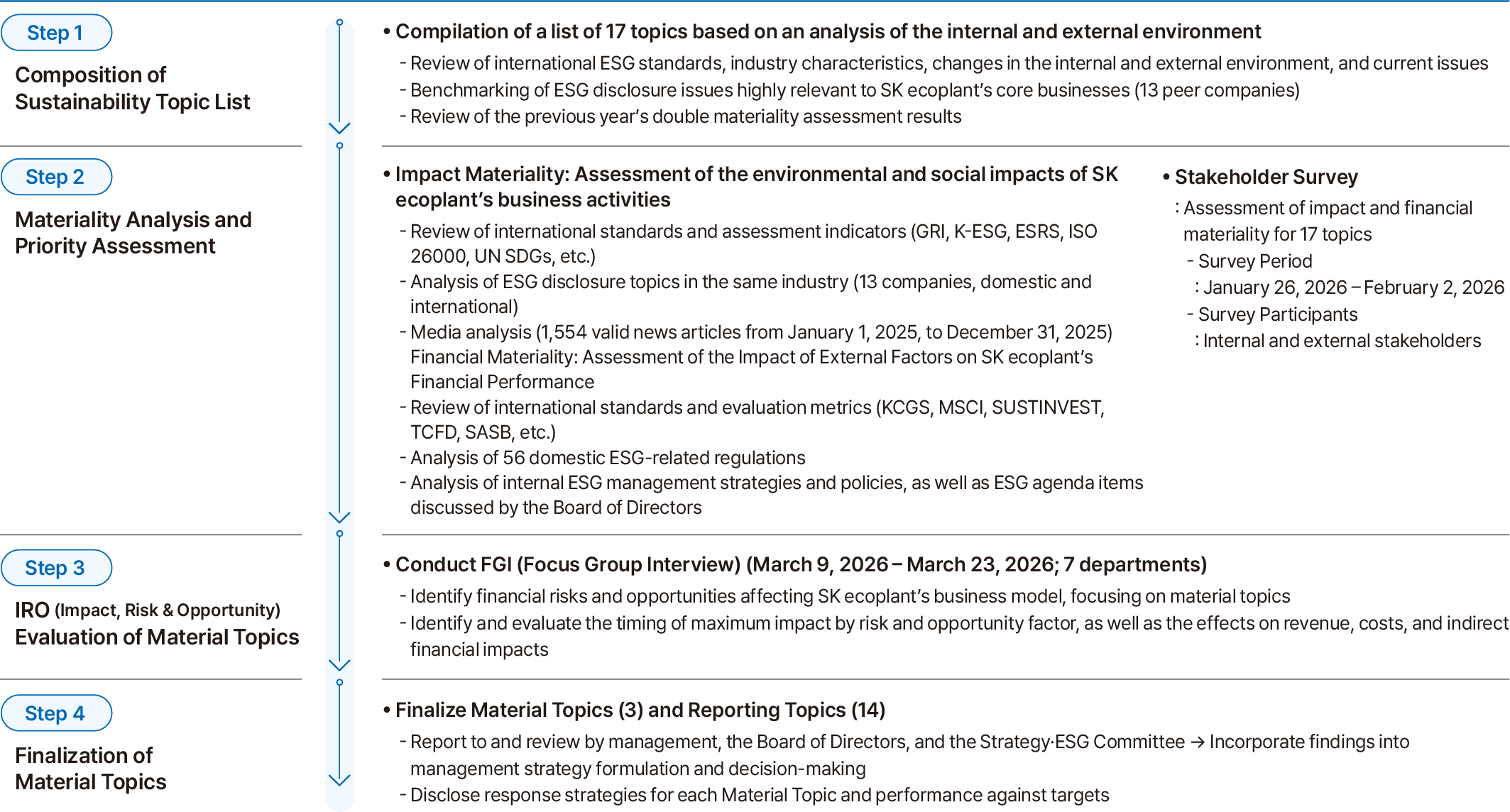
SK ecoplant conducts a double materiality assessment annually in accordance with the GRI Standards’ principles for selecting reporting topics and evaluation methods. This is done to identify key issues from the perspective of sustainability disclosure and to incorporate them into the company’s ESG strategy as well as decision-making processes. A double materiality assessment is a process of deriving priority topics by analyzing the impact, risks, and opportunities associated with sustainability management issues, evaluating both impact and financial materiality. The impact materiality assessment analyzes the actual and potential environmental and social impacts of the company’s activities across the entire value chain, while the financial materiality assessment analyzes how risks and opportunities arising from sustainability issues affect the company’s value creation, cash flow, and access to capital.


Definition of the Double Materiality Assessment


Double Materiality Assessment Process

Double Materiality Assessment Results

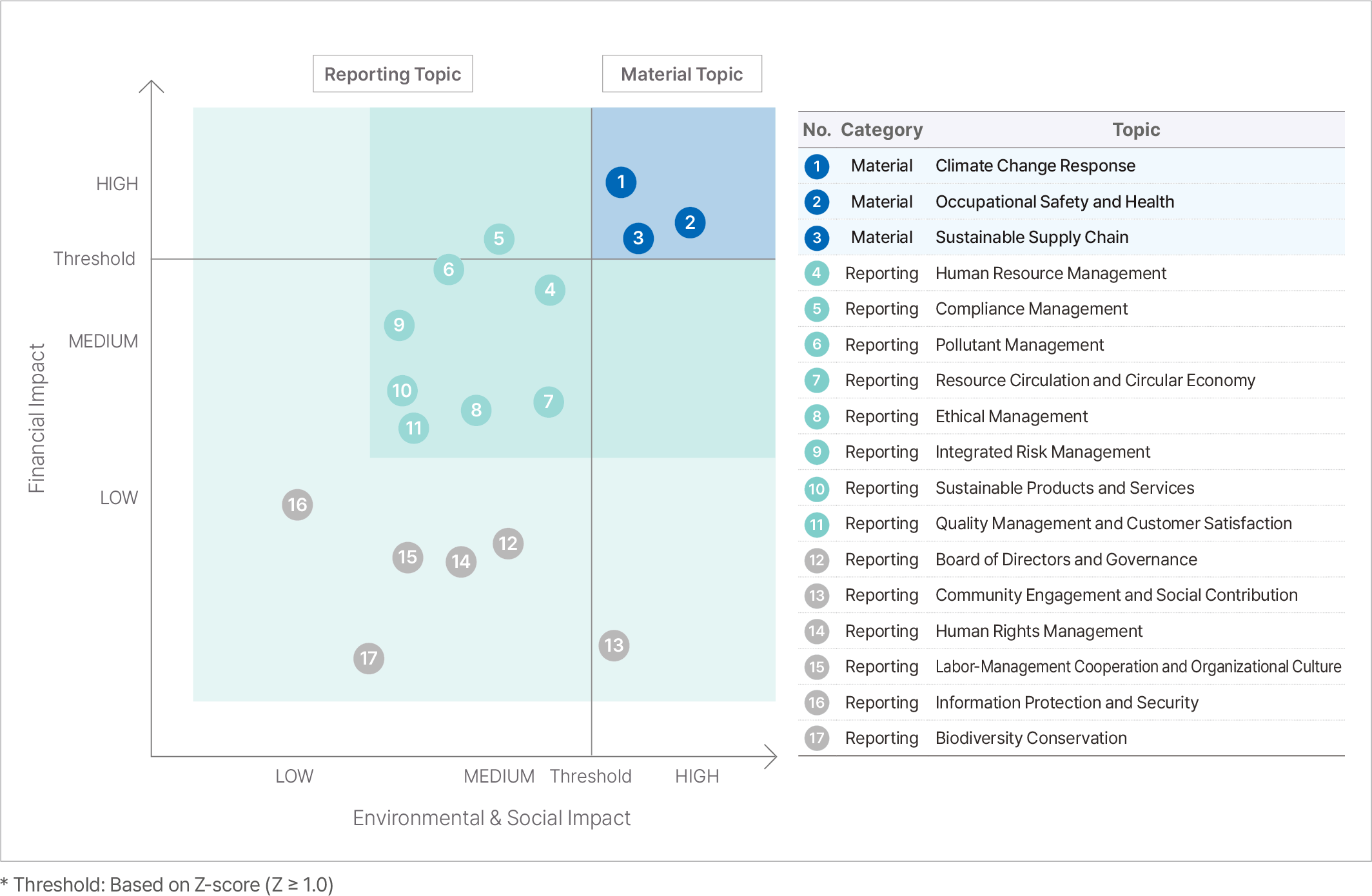
Based on the double materiality assessment and analysis, three issues—Climate Change Response, Occupational Safety and Health, and Sustainable Supply Chain—were identified as high-materiality topics in terms of their environmental, social, and financial impacts. Information regarding the management approach, goals, and performance related to these material topics is disclosed in detail in the “Material Topic” section of this report. Furthermore, SK ecoplant annually reports the results of the double materiality assessment to the Board of Directors and the Strategy·ESG Committee, while also incorporating them into the formulation of management strategies and decision-making.

2025 Double Materiality Assessment Results
Material Topics for 2025

Category

Impact

Scope of Impact

Scope of Key
Stakeholders

GRI

Environmental and Social

Financial

Sites

Supply
Chain

Products &
Services

1

Climate Change
Response

Customers, Government,
Biz. Partners, Employees,
Local Communities

302 305

2

Occupational
Safety and Health


Employees, Biz. Partners

403

3

Sustainable
Supply Chain


Customers, Biz. Partners

308 414


Status and Plans for Addressing Material Topics

For each material topic, SK ecoplant establishes and implements systematic response strategies based on analysis results of positive and negative impacts, as well as risks and opportunities. In addition, the company continuously monitors implementation performance in relation to these strategies and manages them through medium- to long-term plans. The current status and plans for each material topic are disclosed in detail in the “Material Topic” section, which covers the key elements of governance, strategy, risk management, metrics, and targets, based on the ISSB’s (International Sustainability Standards Board) “IFRS S1 General Requirements for Disclosure of Sustainability-related Financial Information” and “IFRS S2 Climate-Related Disclosures.”

Status and Plans for Material Topics

Material Topics

Response Strategy

Implementation Progress (2025)

Mid- to Long-Term Plans

Climate Change
Response

Achieving Net-Zero by 2040

  • Net-Zero Initiatives
    : Streamlining on-site operations,
    expanding the transition to eco-
    friendly vehicles and renewable
    energy, implementation of zero-
    energy buildings, etc.

  • Supply Chain Engagement
    : Transition to low-carbon
    materials, support for subsidiaries
    and Biz. Partners, etc.

  • Development of sustainable
    products and services


  • Greenhouse gas emissions intensity
    : Achieved 2.6 tCO2eq per
    KRW 1 billion

  • Energy intensity
    : Achieved 51.6 GJ per KRW
    1 billion


  • 42% reduction in Scope 1 & 2 by 2030 (compared
    to the base year 2021)

  • 25% reduction in Scope 3 by 2030 (compared to the base year 2021)

Occupational
Safety and Health

Achieve the “Zero Serious Accidents” Goal

  • Establishment of a self-managed
    safety management system

  • Tailored support for on-site workers, including employees and Biz. Partners

  • Strengthening safety management
    status inspection cross-checks


  • Fatality rate per 10,000 workers:
    0

  • 0 serious accidents and fatalities

  • Occupational Safety and
    Health Law Compliance
    Inspection Results: Corrective
    actions completed on 100%
    of areas requiring improvement


  • Achieve an LTIR of 0.414
    by 2030

  • Achieve a fatality rate
    per 10,000 workers of
    0.290 by 2030

  • Achieve zero serious
    accidents and zero
    fatalities by 2030

Sustainable
Supply Chain

Sustainable Supply Chain Management

  • Stable supply and demand
    management and expansion of
    eco-friendly product procurement

  • Supply chain ESG risk management
    through ESG evaluation and Biz.
    Partner improvement

  • Enhancing supply chain
    competitiveness by supporting
    shared growth and nurturing Biz.
    Partners


  • Purchased KRW 158.6 billion
    worth of eco-friendly products

  • Conducted ESG evaluations of
    121 Biz. Partners (80% of core
    Biz. Partners)

  • Completed 100% of corrective
    actions on 20 Biz. Partners
    under priority management

  • Achieved the highest rating for 9 consecutive years in the Shared Growth Index evaluation


  • Expansion of the scope of the supply chain ESG
    evaluation (Targets based
    on core Biz. Partners:
    83% in 2026, 84% in 2027)

Stakeholder Communication


SK ecoplant defines its key stakeholders—in accordance with the SK Group’s SKMS (SK Management System) management system—as shareholders and investors, employees, customers, Biz. Partners, and local communities, and strives to maximize their collective happiness. To this end, the company operates tailored communication channels for each stakeholder group and has established ESG management as a key communication theme, covering areas such as climate change response, occupational safety and health, and ethical management. Furthermore, the diverse needs of stakeholders identified during business and operational processes are incorporated into sustainable management activities. Since 2023, SK ecoplant has published a standalone Sustainable Management Report on a dedicated webpage to effectively disclose its various ESG management activities, goals, and achievements, thereby enhancing stakeholders’ access to information.


Current Status and Plans for Stakeholder Communication Channels

Category

Communication Channels

Goals and Strategies

Short-Term

Long-Term

Shareholders and
Investors

Analyst–
Investor
Meetings

  • Effective communication
    and dissemination of the
    company’s financial story

  • Establishing a reputation
    as an ESG leader, securing future demand for ESG
    investments

  • Regular communication
    with analysts

  • Conducting domestic and
    international IR for potential
    investors

  • Analyst Report
    publication support

  • Conducting IR Events for
    key business units

General
Meeting of
Shareholders

  • Strengthening
    shareholder rights
    through company-
    shareholder
    communication

  • Providing information on
    management status
    through the General
    Meeting of Shareholders

  • Improving shareholder
    friendliness through
    events

Employees

Internal
Portal

  • Enhancing understanding
    through timely sharing of
    company-wide key trend
    and business information

  • Regularly publishing
    content for the
    enhancement of business
    understanding and activation of communication

  • Utilizing channel use
    experience analysis to
    identify content
    dissemination strategies
    and channel
    improvements

CEO Lounge
within the
Internal
Portal

  • Enhancing business
    understanding and trust
    through communication
    with the CEO

  • Immediate Delivery of CEO messages

  • Sharing the CEO’s
    management philosophy
    and activities

  • Expanding communication
    channels between the
    CEO and employees

Culture
Survey
(Engagement
Survey)

  • Identifying employee
    needs to improve
    company culture

  • Policy, system improvement
    and organizational
    development based on
    employee VoC

  • Developing and
    implementing innovation in work practices and
    culture

Management
Development
Council

  • Promoting advancement
    through mutual
    understanding and
    cooperation between
    management and
    employees

  • Actively implement
    employee feedback on
    policy and organizational
    culture through regular
    Empathy Meetings

  • Strengthening council
    representativeness by
    operating an employee-
    centered council and
    expanding continuous
    participation and
    communication

Customer

Website and
Social Media

  • Conveying sustainable
    management strategies
    and key business
    portfolios’ values and
    performance

  • Official channels that
    present company
    information, such as vision,
    goals, and business
    direction, in the form of
    optimized content

  • Reinforcing continuous
    company brand value
    growth and
    communication

NEWSROOM

  • As a contents platform for
    ESG management and
    core businesses, provide
    differentiated information
    to external stakeholders
    such as media, investors,
    industry professionals

  • Creating and distributing
    content on ESG management, core business information,
    and knowledge

  • Providing additional
    information and contents
    on company PR as well as
    press releases

  • Bolstering NEWSROOM’s
    role as a dedicated
    content platform for ESG management and core
    businesses

Biz. Partner

ECO Partners
Meeting

  • Fostering closer
    relationships and mutual
    understanding through
    Annual General Meetings, Biz. Partner factory visits,
    Green Meetings,
    roundtables, and Shared
    Growth Day

  • Improving the methods
    and scope of participants
    for regular events

  • Strengthening the
    consultative body’s role as a communication
    channel

  • Developing programs
    tailored to Biz. Partners’
    needs

Eco ESG
Bridge
(Newsletter)

  • Building consensus on
    ESG activities by sharing
    ESG concepts, trends,
    and best practices

  • Newsletter promotions for
    Biz. Partners

  • Providing information
    regarding shared growth
    programs

  • Quantitative and
    qualitative enhancement
    of content

Local
Communities

Social
Contribution
Programs

  • Expanding positive
    impact for future
    generations and local
    communities

  • Conducting a multitude of
    social contribution activities,
    such as community
    environmental cleanup and
    improving living conditions

  • Establishing a mid- to
    long-term roadmap for
    social contribution and
    operation processes, in
    addition to managing
    performance