
Compliance Management System
Compliance Guidelines and Operating Regulations
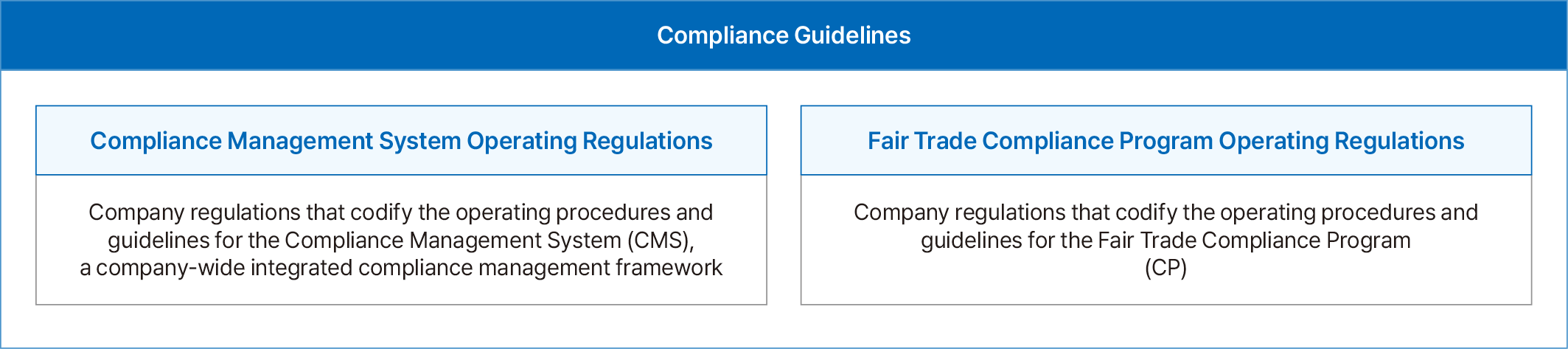
SK ecoplant has been operating the Fair Trade Compliance Program (CP) since 2008 to foster a transparent and mature compliance culture. For the systematic operation of the internal Compliance Management System (CMS) and the CP, the company appointed a Compliance Officer in 2025 and established the “Compliance Guidelines.” The Compliance Guidelines serve as the top-level company regulations governing the operation of the company-wide Compliance Management System (CMS). They define the standards and procedures for compliance control activities—which involve assessing all laws and regulations applicable to business operations and enabling employees to self-monitor their compliance to prevent illegal acts.
 | ||
|---|---|---|
Fair Trade Policy (Compliance Handbook)
Since first establishing the “Fair Trade Compliance Handbook” in 2008, SK ecoplant has been using it as an operational guideline to establish a fair trading order. The handbook selects and includes regulations highly relevant to the company’s business structure, contract types, and stakeholders, and periodic revisions are issued to reflect changes in the policy environment, regulatory amendments, and the latest violation cases. In 2025, the revision cycle was expanded from once a year to twice a year, resulting in the publication of the 8th and 9th revised editions. This revision incorporated four new or amended legal provisions—including revisions to the notice and review guidelines on unfair special agreements, as well as the enactment of operational guidelines for the subcontract payment linkage system—along with 19 new cases of violations of fair trade laws. The 9th edition was also produced as an e-book to enable access via PCs and smartphones. For the Subcontracting Act section of the handbook—which is highly relevant to the daily work of on-site staff—the company separately produced and distributed a revised edition of the “Compliance Handbook - Subcontracting Act,” containing practical guidelines, processes for preventing legal violations, and checklists.
Status of Revisions to the Compliance Handbook
Category | 2008 | 2011 | 2015 | 2017 | 2021 | 2022 | 2023 | 2024 | 2025 |
|---|---|---|---|---|---|---|---|---|---|
Revision | Enactment | 1st | 2nd | 3rd | 4th | 5th | 6th | 7th | 8th-9th |
Relevant |
| ||||||||
Structure |
| ||||||||
Compliance Management System
Compliance Management System (CMS)
SK ecoplant established a company-wide integrated Compliance Management System (CMS) in 2023 to proactively respond to changes in the internal and external business environment and prevent compliance risks. In 2024, the company developed a CMS IT platform to establish an IT-based risk management system capable of identifying and responding to key compliance information—such as regulatory amendments, policy trends, and industry violation cases—in real time. Through this platform, the company supports collaboration among relevant departments, monitors management status in real time via dashboards, and accumulates management histories for various risk types within the system to strengthen its risk management capabilities. Since 2023, based on the operational performance of the CMS, SK ecoplant has obtained and maintained the international ISO 37301 (Compliance Management System) certification, thereby demonstrating the compliance of its integrated compliance risk management system with international standards.
Fair Trade Self-Compliance Program (CP: Compliance Program)
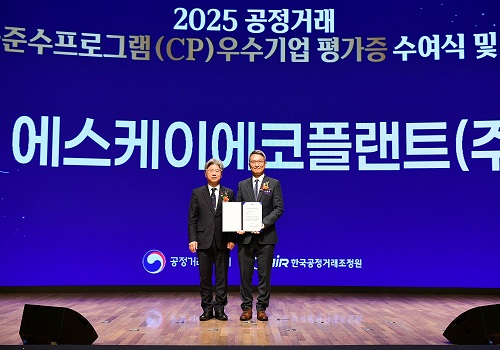
To ensure systematic CP operations, SK ecoplant has established relevant regulations and rules as company policies, and practices strict adherence to them. Every year, all employees—including the CEO—sign a compliance commitment pledge, reaffirming their commitment to fair trade. In 2025, to strengthen compliance execution, the company incorporated internal audit results into its KPIs and bolstered the effectiveness of CP operations by maintaining a completion rate of 90% or higher for all compliance training programs. As a result, in 2025, SK ecoplant became the first large corporation to achieve the highest AAA rating for three consecutive years in the Fair Trade Commission’s Fair Trade Compliance Program evaluation. This achievement stems from the company’s efforts since introducing the CP in 2008 to continuously strengthen its internal audit framework through the establishment of clear operational standards and procedures, as well as the operation of a compliance management system—all while ensuring that every executive and employee actively participates in the CP to prevent legal violations.
 | ||
|---|---|---|
Compliance Governance
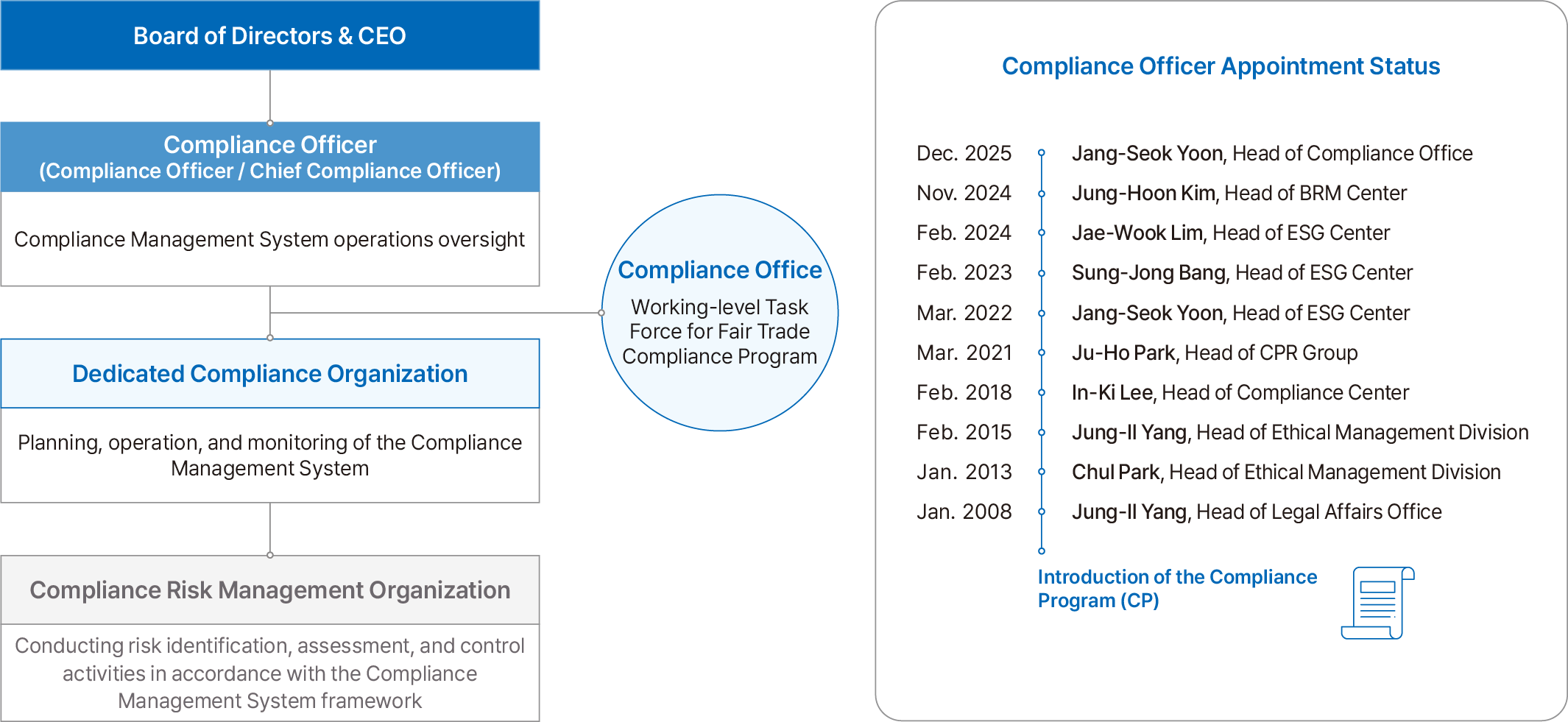
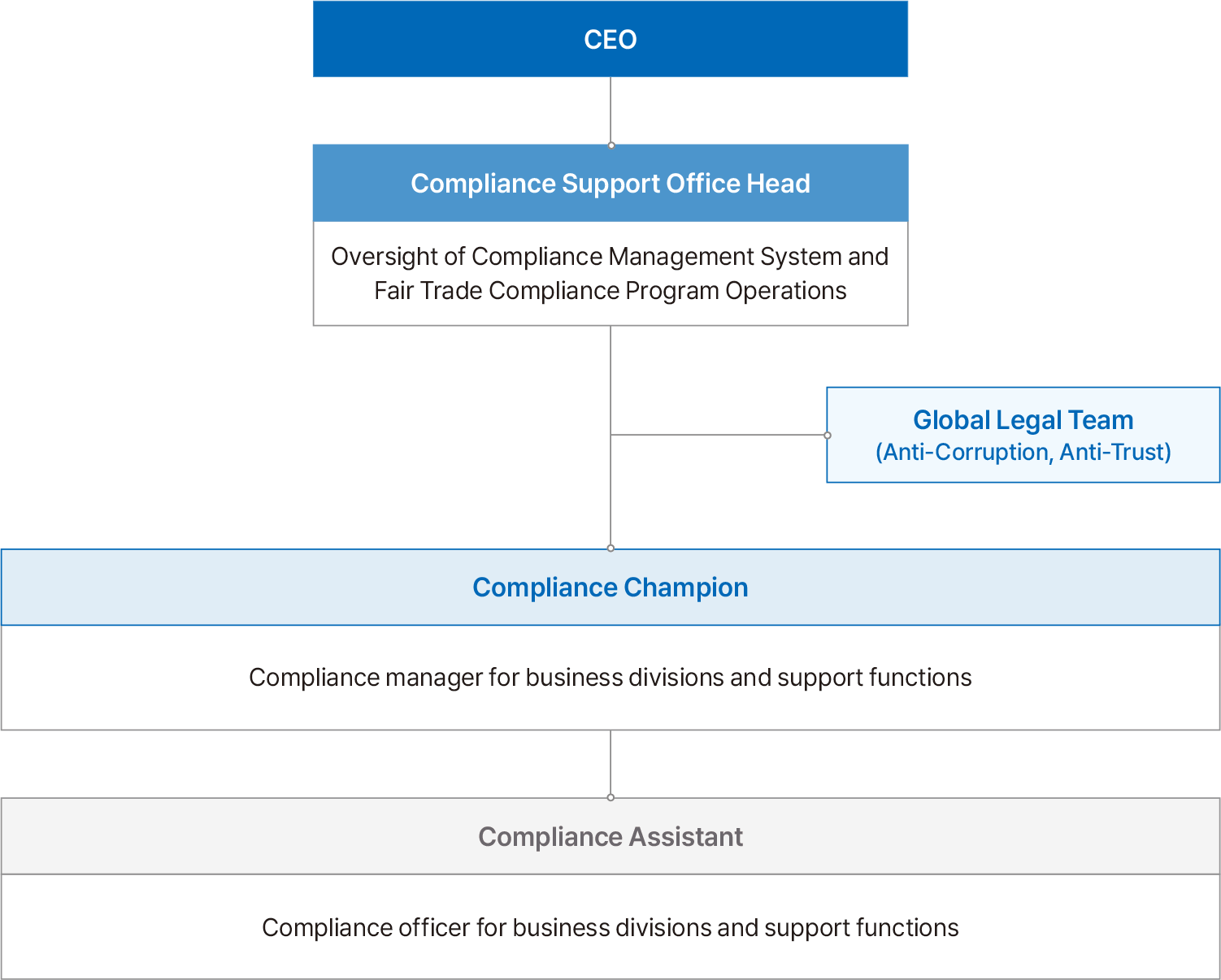
At SK ecoplant, a Board-appointed Compliance Officer (who also serves as the Chief Compliance Officer) oversees the systematic and independent operation of the Compliance Management System. The system’s operational plans and results are reported to top management on a quarterly basis, while operational standards are continuously improved by incorporating feedback from these reviews. In addition, since establishing a Dedicated Compliance Organization in 2022 to oversee the operation of the Compliance Management System, the company has been continuously expanding and maintaining dedicated staff to strengthen compliance capabilities. In particular, to ensure that the Fair Trade Compliance Program—which requires company-wide collaboration—can be operated under a single-team structure, SK ecoplant has established the Compliance Office by integrating personnel from relevant departments, such as the Ethics Management Team and Legal Team. The office reports directly to the CEO, enabling organic and coordinated operations.
Compliance Management Organizational Chart
Duties and Authority of Compliance Officers
Category | Details |
|---|---|
Authority and Duties of the | ① The Compliance Officer shall have the following authorities: ② The Compliance Officer may seek advice and assistance from external experts when necessary. ③ The Compliance Officer must perform his or her duties with the care expected of a prudent |
Authority and Duties of the Chief | ① The Chief Compliance Officer shall perform the roles listed in the following subparagraphs to ② The authorities of the Chief Compliance Officer is as follows: ③ The duties of the Chief Compliance Officer are as follows: |
Compliance Risk Management
Risk Management Through the Compliance Management System
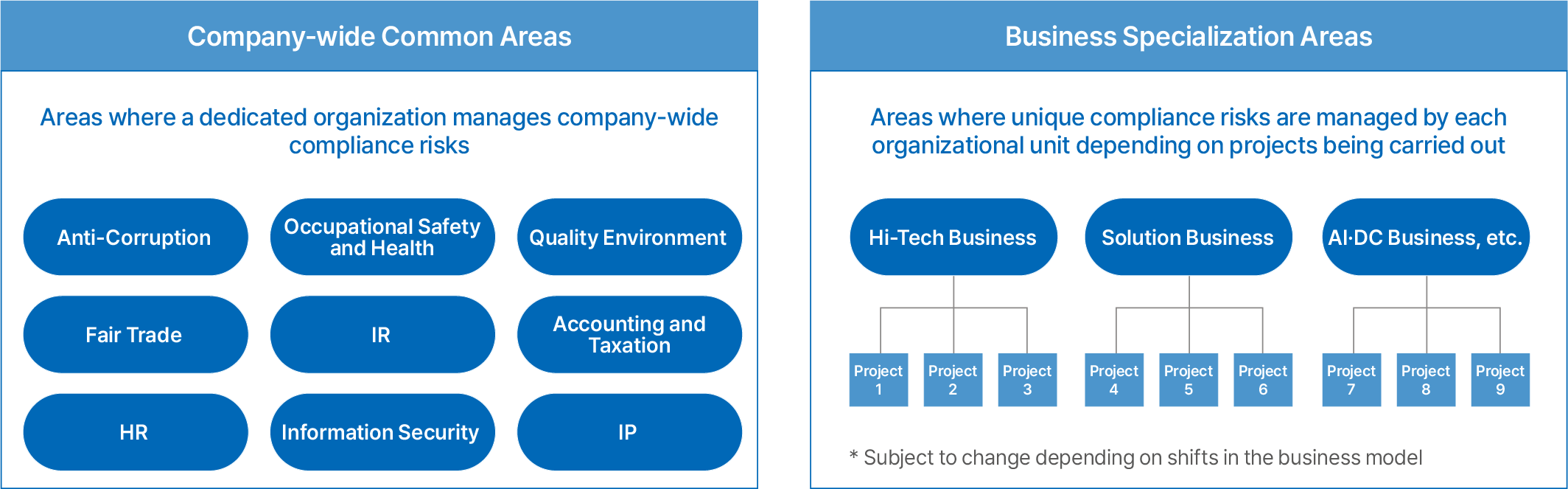
To prevent compliance risks, SK ecoplant is operating a company-wide, IT-based integrated Compliance Management System (CMS). The real-time collaboration of all organizational units across the company is supported via an IT platform throughout the entire risk management process—including risk identification, risk analysis, and the development and improvement of control measures. Systematic and efficient risk management is conducted through the maintenance of a dedicated database.
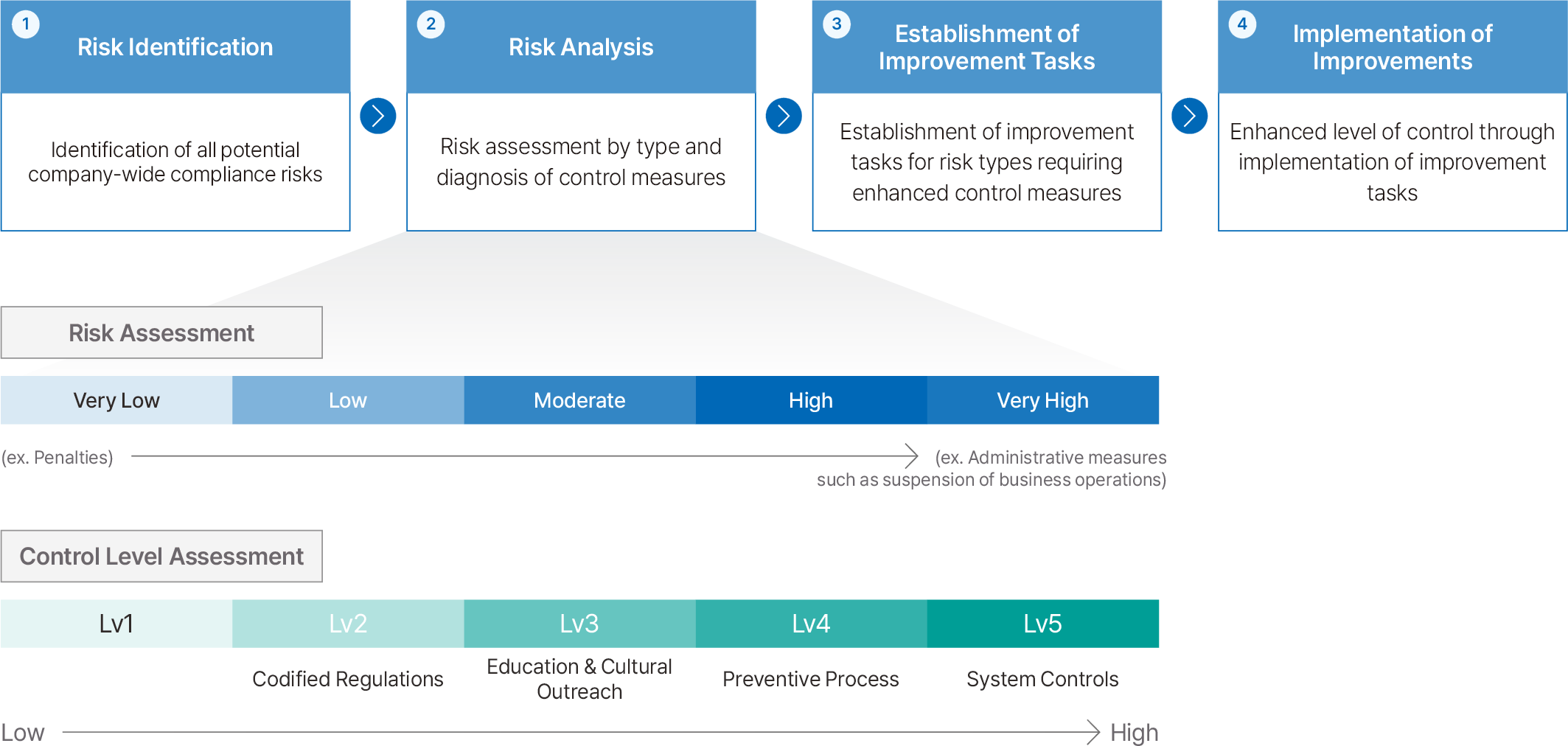
Through analysis of business models and operational processes, SK ecoplant identifies areas subject to compliance requirements as well as applicable regulations, and systematically identifies all types of risks that may arise during operations. For each identified risk type, the company assesses risk level by comprehensively evaluating the likelihood of occurrence and the potential impact—which reflects the severity of penalties in the event of a violation—through regular and ongoing monitoring. The organizations responsible for managing each risk then establish and implement regulations, conduct training, build operational processes, and carry out system control activities necessary for prevention. After evaluating the effectiveness of control measures, if the level of control is found to be insufficient relative to the risk level, SK ecoplant develops and implements improvement plans to continuously enhance the level of control. All results are reported transparently to senior management.
Compliance Management Areas
Compliance Risk Management Process
Fair Trade Risk Management
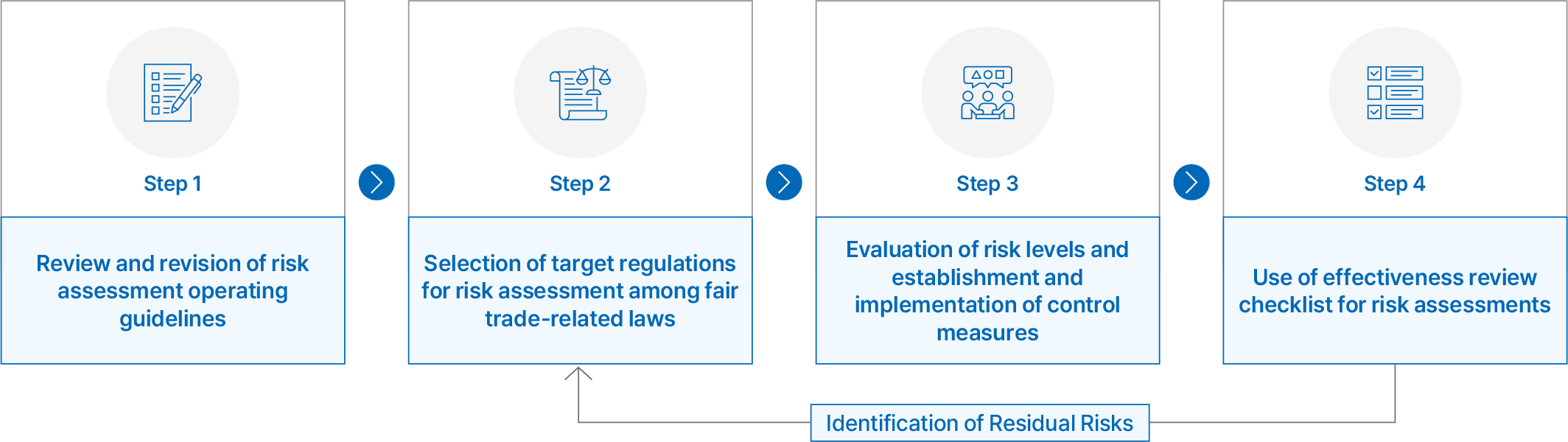
SK ecoplant conducts fair trade risk assessments to identify and mitigate risks related to fair trade practices. To ensure the effective execution of these assessments, the company has established a separate Fair Trade Risk Management Guideline, which clearly defines the assessment procedures, target areas, and criteria for risk levels (five stages, from lowest to highest). In accordance with this guideline, fair trade risk assessments are conducted quarterly. Areas with potential legal risks are proactively identified, and a variety of risk control activities are carried out, including employee compliance training, distribution of compliance guidelines, implementation of a pre-consultation system, post-inspection and sanctions, and operation of an internal reporting system. In 2025, taking into account business relevance, industry-wide violation cases, and recent amendments to relevant laws, SK ecoplant designated the Monopoly Regulation and Fair Trade Act, Fair Transactions in Subcontracting Act, Act on Fair Labeling and Advertising, and the Act on the Regulation of Terms and Conditions as key regulations to manage. For each of these laws, risk factors were analyzed by clause, related departments were identified, and causes were analyzed to establish and implement specific risk control measures.
Fair Trade Risk Assessment Process
Fair Trade Risk Assessment Results
Category | Key Risks | Improvement Measures | Risk Level1) | |
|---|---|---|---|---|
Before | After | |||
Subcontracting |
|
| Level 4 | Level 3 |
1) Risk levels are categorized into five stages, with level 1 being the lowest and level 5 being the highest.
Compliance Violation Inspection
Pre-Review and Post-Inspection System
Through its Compliance Management System, SK ecoplant proactively reviews and inspects potential compliance risks that may arise during business operations, continuously monitoring for possible violations. If any violations are discovered, corrective actions are implemented immediately, while disciplinary measures are taken in accordance with internal policy when necessary. Since 2021, the company has operated a “Compliance KPI Deduction System,” which deducts organizational KPI scores based on regulatory violations. The scope and severity of these deductions have been continuously expanded since the system’s introduction. In 2025, SK ecoplant introduced new criteria to award bonus points for outstanding examples of Compliance Management System operation.
Status of Compliance KPI Deduction System
Category | 2021 | 2022 | 2023 | 2024 | 2025 |
|---|---|---|---|---|---|
Scope of |
|
|
|
|
|
Maximum | 5 points | 10 points | 10 points | 10 points | 10 points |
1) Points deducted from the total KPI score of 100
CASE | Subcontracting Act Compliance Inspections |
|---|
SK ecoplant conducts regular inspections to ensure no legal violations occur during the execution of subcontracting transactions. For all domestic projects, the company inspects for violations of the Subcontracting Act’s 13 items (including payment of subcontractor fees and prohibition of unfair reductions) corresponding to the Fair Trade Commission’s written status survey. If any issues are identified, corrective measures are taken immediately, and disciplinary actions are imposed depending on case severity. To ensure the disclosure of subcontractor payment details, SK ecoplant reviews whether all subcontractor payments have been made in accordance with the law; any deficiencies are immediately rectified before final disclosure.

Global Compliance Activities
SK ecoplant is building and operating a global-level compliance management system in alignment with the expansion of its new businesses and the overseas networks of key subsidiaries. Following global acquisitions, investments, and mergers, the company has introduced and enforced various regulations to prevent legal violations, including anti-corruption and compliance procedures, overseas conflict of interest policies, and anti-bribery rules for global suppliers. In 2025, in response to major changes in international law—including revisions to the U.S. Foreign Corrupt Practices Act (FCPA) guidelines, the introduction of the UK’s “Failure to Prevent Fraud” offense, and amendments to the EU Corporate Sustainability Due Diligence Directive (CSDDD)—the company conducted an annual review and revision of its anti-corruption compliance regulations. In addition, through the operation of quarterly global compliance committees for each subsidiary, the company revised the due diligence checklists for third parties (agents, brokers, and subcontractors) to meet the evaluation criteria of the U.S. Department of Justice and the UK Serious Fraud Office. The aforementioned measures were supplemented by anti-corruption and compliance training. By also assessing the effectiveness of its internal reporting channels, SK ecoplant verified the adequacy of its anonymity and whistleblower protection policies. Moreover, an evaluation was conducted to determine each subsidiary’s compliance with the revised EU Corporate Sustainability Due Diligence Directive (CSDDD) and Corporate Sustainability Reporting Directive (CSRD). SK ecoplant aims to continue refining relevant regulations while enhancing institutional mechanisms and management systems.
Global Compliance Organizational Chart
Compliance with Fair Trade Laws and Regulations
SK ecoplant thoroughly reviews legal risks that may arise from its business activities to ensure compliance with domestic and international fair trade regulations. In addition, the company monitors violations by type to manage the status of fair trade violations.
Fair Trade Training
SK ecoplant provides case-based and job-specific compliance training to all employees, including the CEO, executives, contract workers, and temporary staff, tailored to the relevance of their duties. In 2025, the company provided a total of 5,613 hours of fair trade training, including company-wide training, job- and level-specific training, as well as special training.
Fair Trade Training by Target Group
Category | Target Group | Training Content | No. of Participants |
|---|---|---|---|
Company-wide | Compliance Management System | Concepts, organizational structure, and roles of the Compliance Management System | 3,066 participants |
CEO Compliance Training | Importance of compliance and | 3,406 participants | |
Global Compliance Training | Introduction to overseas anti-corruption laws and real-world case studies | 3,950 participants (97.0%) | |
Training by Job | New Hire Training | Compliance and information security training | 417 participants (100%) |
Training on Internal Transactions for | Overview of internal transactions and self- | 3 participants (100%) | |
Training on Internal Transactions for the CEO and Executives | Key cases and precautions regarding | 47 participants (100%)) | |
Cartel Prevention Training1) | Explanation of the concept of unfair joint | 180 participants (100%) | |
Training on Preventing Unfair Internal | Guidance on practical considerations for | 237 participants (100%) | |
Training on Improvements to the | Training for staff on improvements to the | 219 participants (100%) | |
Pre-training for Project Consulting | Briefing on project background and the | 163 participants (98.8%) | |
Training on Subcontracting Issues | Training to disseminate key information and | 229 participants (100%) | |
Training on Compliance with the | Training on system improvements and work | 101 participants (100%) | |
Training on the Protection of | Case studies on technology misappropriation and guidance on the Technical Data | 2,135 participants (99.4%) | |
Subcontracting Act Training for Field | Key provisions of the Subcontracting Act | 618 participants (100%) | |
Special Training | Compliance Workshop (Training for CP Violators) | Workshop to analyze causes and develop | 36 participants (100%) |
On-site Training (Training for CP | Tailored training on the Subcontracting Act | 23 participants (100%) | |
Remedial Training (Basic CMS | Remedial training for those who have not | 19 participants (90.5%) | |
Remedial Training (CEO Compliance | Remedial training for those who have not | 76 participants (91.6%) |
1) For some training programs, this figure includes participants from subsidiaries
- Cartel Prevention Training: SK ecoengineering (11 participants), SK airplus (5 participants), SK oceanplant (22 participants)
- Training on Preventing Unfair Internal Transactions: SK ecoengineering (22 participants), SK airplus (5 participants), SK oceanplant (24 participants)
- Pre-training for Project Consulting Implementation: SK ecoengineering (1 participant), SK airplus (2 participants), SK oceanplant (2 participants)
Fair Trade Compliance
Operation of the Fair Trade Compliance Program (CP)
Since introducing the Fair Trade Compliance Program (CP) in 2008, SK ecoplant has been conducting various activities centered on eight key elements, including compliance with fair trade laws and the monitoring of fair trade practices. The details of the 2025 Compliance Program operations are as follows.
Fair Trade Compliance Program (CP) Operational Activities
Date | Activity |
|---|---|
Jan. 22, 2025 | Publication of the regular “CP Letter” newsletter _ Compliance Handbook usage methods |
Jan. 23, 2025 | Publication of the regular “CP Letter” newsletter _ CMS platform grand opening & training (total of |
Feb. 4, 2025 | Fair trade and subcontracting project consulting training (total of 158 participants, 99% completion |
Feb. 28, 2025 | Training on the prohibition of requests for technical data and TDMS (Technical Data Management |
Mar. 4, 2025 | Solicitation of consent and pledges regarding compliance with laws on personal data processing, |
Mar. 6, 2025 | Report to the Board of Directors on the 2025 Compliance Operations Plan |
Apr. 1, 2025 | Fair Trade Day: Raising awareness of the importance of the Fair Trade Compliance Program (CP) via SK ecoplant’s social media accounts |
Apr. 16, 2025 | Publication of the regular “CP Letter” newsletter _ awards presented to sites with outstanding |
May 27, 2025 | Publication of the regular “CP Letter” newsletter _ employee invention reporting and compensation |
Jun. 12, 2025 | Training on preventing unfair collusion (total of 142 participants, 100% completion rate) |
Jun. 25, 2025 | 2025 SUPEX Award _ Establishment and excellent operation of an integrated compliance risk |
Jul. 1, 2025 | Award ceremony for outstanding compliance organizations in the second quarter (improvement of |
Jul. 7, 2025 | Training on the prevention of improper insider transactions (total of 186 participants, 100% completion rate) |
Jul. 15, 2025 | CEO Report on compliance operations for the first half of 2025 |
Jul. 31, 2025 | Publication of the regular “CP Letter” newsletter _ Improvements to the verification process for multiple trade licenses |
Aug. 26, 2025 | CEO-led compliance training (total of 3,406 Participants, 99% Completion Rate) |
Sep. 1, 2025 | Training for CEOs and executives on preventing information exchange collusion and unfair internal |
Sep. 1, 2025 | Revision of the Compliance Management System Operating Regulations |
Sep. 8, 2025 | 2025 global compliance training (total of 3,950 participants, 97% completion rate) |
Sep. 30, 2025 | Publication of the regular “CP Letter” newsletter _ Anonymous Reporting Channel “CP HOT-LINE” |
Sep. 30, 2025 | 8th Revision of the Fair Trade Compliance Handbook |
Oct. 2, 2025 | CEO Report on compliance operations for the third quarter of 2025 |
Oct. 17, 2025 | Awards Presented to sites with outstanding compliance (safety, quality, and subcontracting) in the |
Oct. 31, 2025 | Publication of the regular “CP Letter” newsletter _ Report on compliance issues and and guidance on |
Nov. 3, 2025 | SK ecoplant achieves top rating in Shared Growth Index Evaluation for 9 consecutive years |
Nov. 6, 2025 | Refresher training for employees who did not attend mandatory training (total of 95 Participants, 91% |
Nov. 20, 2025 | Awards presented to outstanding compliance organizations for the fourth quarter |
Nov. 27, 2025 | Report to the Board of Directors on 2025 compliance operations results |
Nov. 28, 2025 | Publication of the regular “CP Letter” newsletter _ Survey on the Fair Trade Compliance Program (CP) |
Dec. 1, 2025 | CEO Message: Urging the Practice of Compliance by Upholding Fundamentals and Principles |
Dec. 1, 2025 | Penalties (warnings issued in the name of the Chief Compliance Officer) for employees who have not |
Dec. 8, 2025 | Training on the Subcontracting Act to protect suppliers’ technical data (total of 2,135 participants, |
Dec. 9, 2025 | Revision and on-site distribution of the “Compliance Handbook - Subcontracting Act” (90 copies) |
Dec. 10, 2025 | Conducted on-site compliance workshops |
Dec. 18, 2025 | 9th Revision of the Fair Trade Compliance Handbook, E-book publication |
Dec. 19, 2025 | Fair Trade Compliance Program (CP) evaluation: Achieved the highest rating (AAA) for three |
Dec. 22, 2025 | Board of Directors approved appointment of the Compliance Officer/Chief Compliance Officer |
Dec. 22, 2025 | Board of Directors approved establishment of Compliance Guidelines |
Dec. 26, 2025 | Publication of the regular “CP Letter” newsletter _ Establishment of Compliance Guidelines |
Compliance Activities
Pledge on Principles for Participating in Industry Meetings and Prevention of Bid Collusion
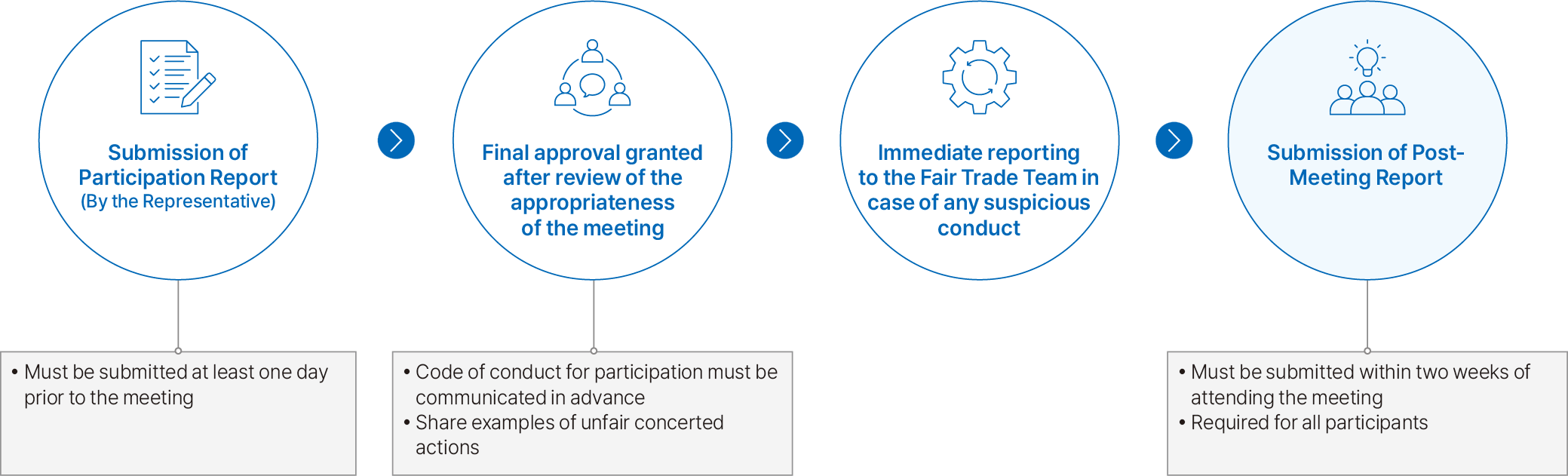
To prevent unfair concerted actions during participation in industry meetings, SK ecoplant operates a pre-reporting system for industry meetings. Participants are required to complete a pre-report form specifying the purpose of attendance and the number of participants, and must sign a Pledge to Comply with Industry Meeting Participation Principles, which includes a code of conduct for such meetings. Prior approval from the Fair Trade Team Leader is mandatory before attending (39 pledges signed in 2025). Any suspicious conduct must immediately be reported to the Fair Trade Team, while post-meeting reports on the occurrence of any legal violations must be submitted to the Fair Trade Team. Through this process, both pre- and post-participation activities are closely monitored.
Pre-Reporting System for Industry Meetings
Pre-Review for Compliance with the Subcontracting Act
When entering into subcontract agreements, SK ecoplant uses the standard subcontract agreement and conducts a pre-review with the Fair Trade Team and Legal Team to ensure that no items in the special terms & conditions and site briefing documents conflict with the Subcontracting Act. In 2025, a total of 702 site briefing documents were reviewed.
Pre-Review Process for the Subcontracting Act

Prevention of Technology Misappropriation and Unfair Use Against Biz. Partners
To protect subcontractors' technical data, SK ecoplant operates the Technical Data Management System (TDMS), which requires verification of whether submitted documents qualify as technical data during the contract and bidding stages, along with mandatory issuance of a technical data request form and execution of a non-disclosure agreement. The contract and bidding process is continuously monitored through the system, ensuring that technical data request forms and NDAs are properly executed to prevent legal violations such as technology misappropriation or unfair use by subcontractors. In 2025, SK ecoplant conducted a comprehensive review of all 1,795 requests for technical data eligibility verification and request form issuance, corrected all errors in legally required information, and issued 81 technical data request forms.
Technical Data Request Management Process

Prevention of Misleading or False Advertising
To prevent violations of advertising regulations and protect stakeholders from misleading or exaggerated claims in promotional materials, SK ecoplant requires pre-review by the Fair Trade Team or Legal Team before distribution. In 2025, a total of 6 promotional materials, including real estate listing advertisements, were reviewed. Potentially misleading language was corrected in advance to prevent violations of the Act on Fair Labeling and Advertising.