
Double Materiality Assessment
Overview of Double Materiality Assessment
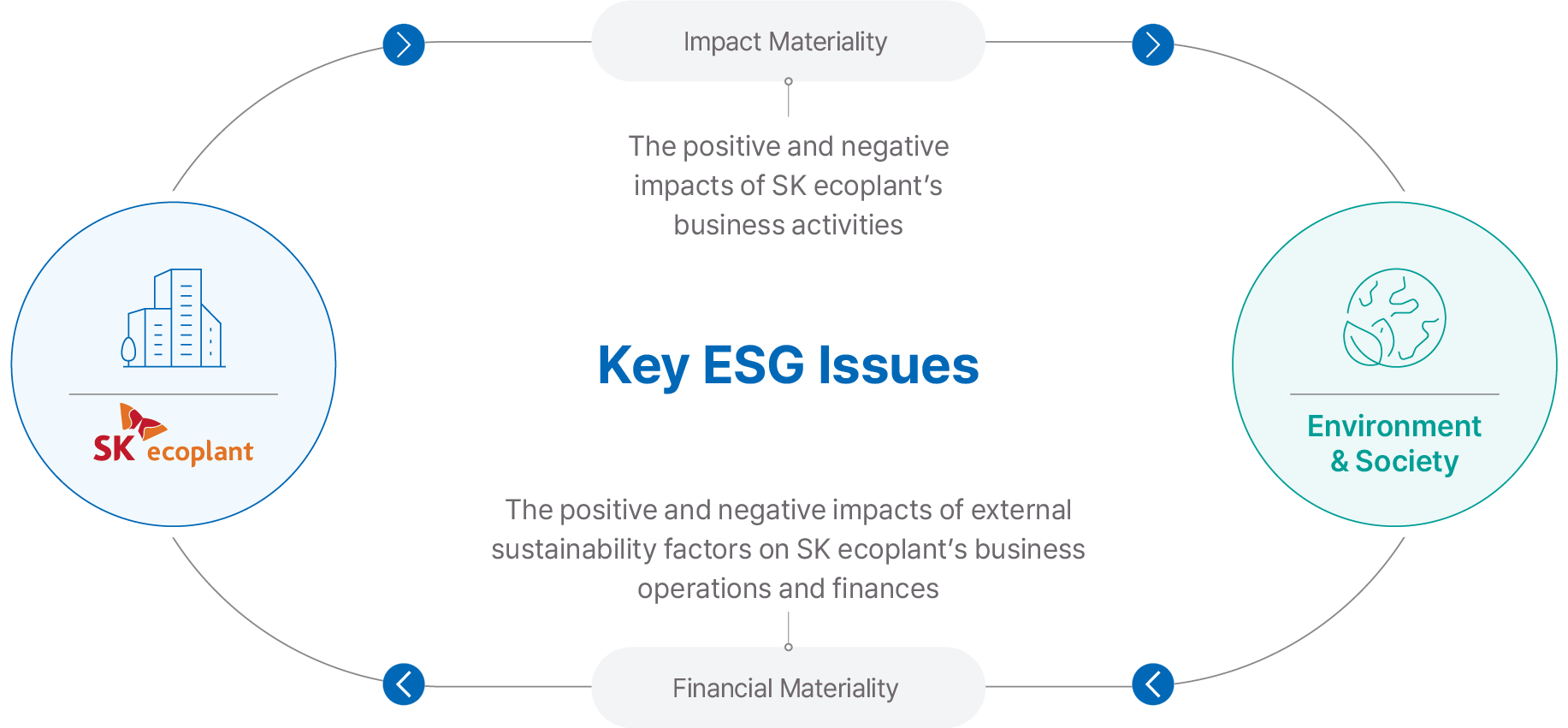
SK ecoplant conducts a double materiality assessment annually in accordance with the GRI Standards’ principles for selecting reporting topics and evaluation methods. This is done to identify key issues from the perspective of sustainability disclosure and to incorporate them into the company’s ESG strategy as well as decision-making processes. A double materiality assessment is a process of deriving priority topics by analyzing the impact, risks, and opportunities associated with sustainability management issues, evaluating both impact and financial materiality. The impact materiality assessment analyzes the actual and potential environmental and social impacts of the company’s activities across the entire value chain, while the financial materiality assessment analyzes how risks and opportunities arising from sustainability issues affect the company’s value creation, cash flow, and access to capital.
Definition of the Double Materiality Assessment
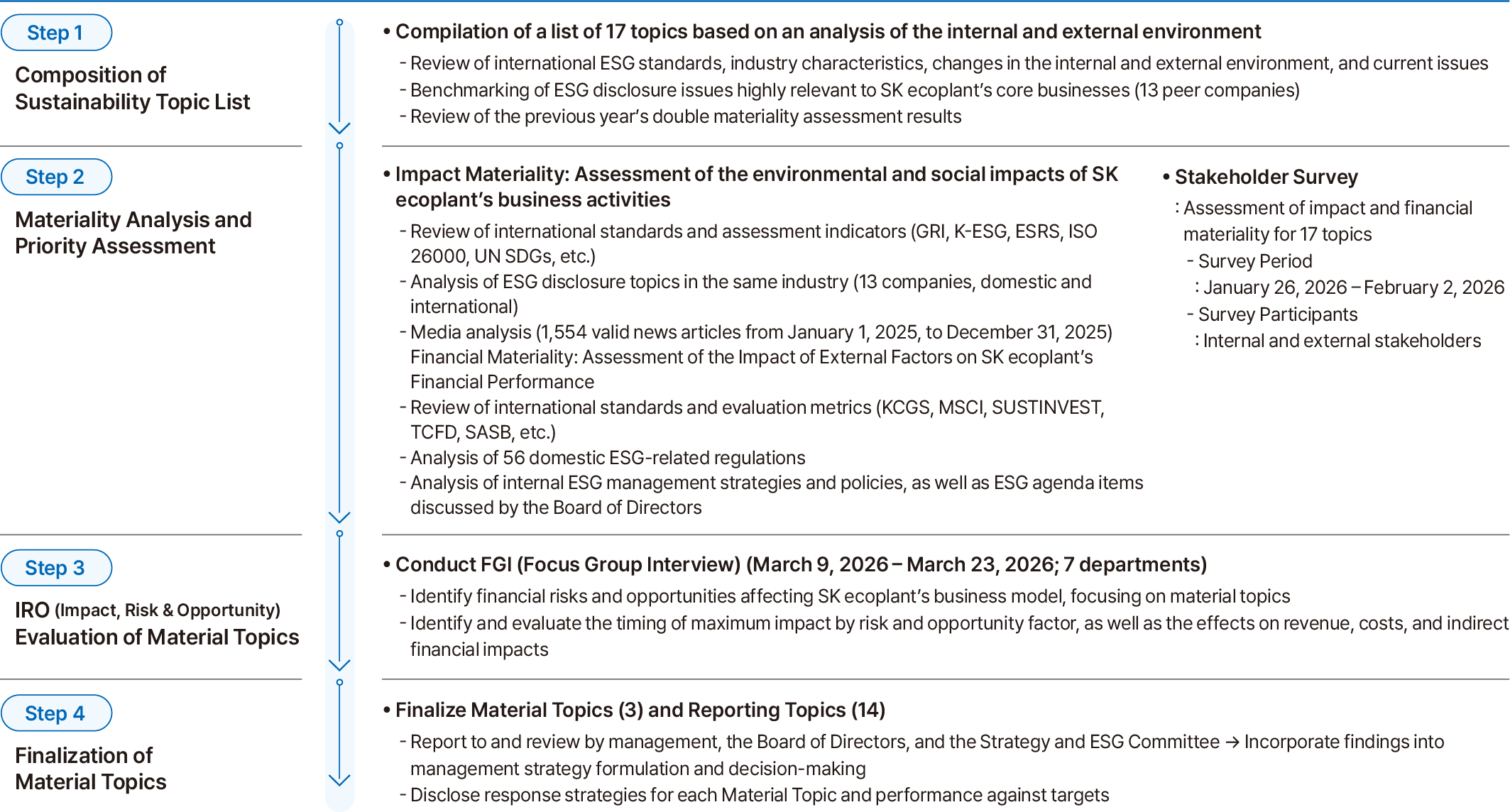
Double Materiality Assessment Process
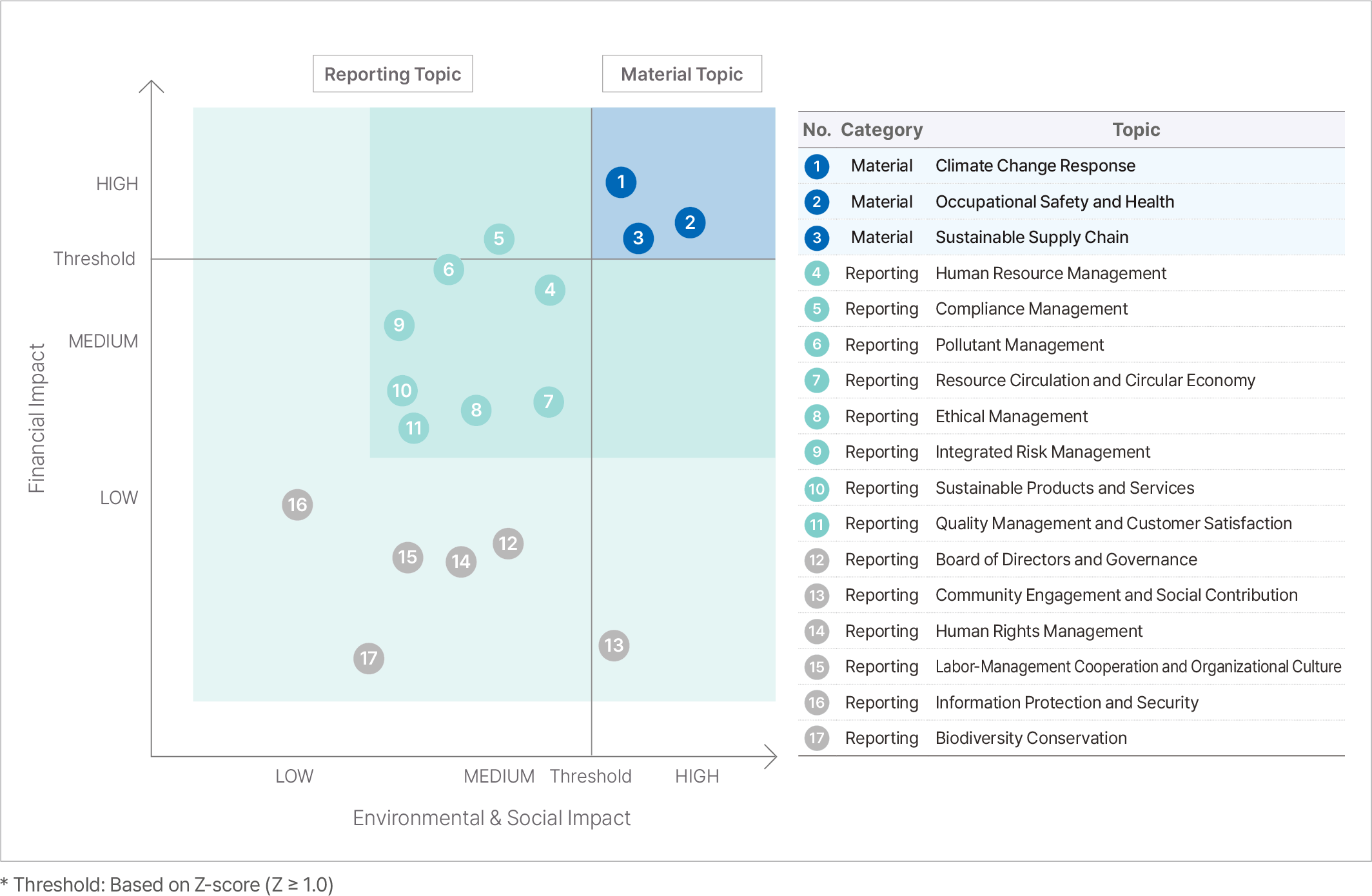
Double Materiality Assessment Results
Based on the double materiality assessment and analysis, three issues—Climate Change Response, Occupational Safety and Health at Worksites, and Sustainable Supply Chain—were identified as high-materiality topics in terms of their environmental, social, and financial impacts. Information regarding the management approach, goals, and performance related to these material topics is disclosed in detail in the “Material Topic” section of this report. Furthermore, SK ecoplant annually reports the results of the double materiality assessment to the Board of Directors and the Strategy and ESG Committee, while also incorporating them into the formulation of management strategies and decision-making.
2025 Double Materiality Assessment Results
Material Topics for 2025
Category | Impact | Scope of Impact | Scope of Key | GRI | ||||
|---|---|---|---|---|---|---|---|---|
Environmental and Social | Financial | Sites | Supply | Products & | ||||
1 | Climate Change |  |  |  |  |  | Customers, Government, Biz. Partners, Employees, Local Communities | 302 305 |
2 | Occupational |  |  |  |  | Employees, Biz. Partners | 403 | |
3 | Sustainable |  |  |  |  | Customers, Biz. Partners | 308 414 | |
Status and Plans for Addressing Material Topics
For each material topic, SK ecoplant establishes and implements systematic response strategies based on analysis results of positive and negative impacts, as well as risks and opportunities. In addition, the company continuously monitors implementation performance in relation to these strategies and manages them through medium- to long-term plans. The current status and plans for each material topic are disclosed in detail in the “Material Topic” section, which covers the key elements of governance, strategy, risk management, metrics, and targets, based on the ISSB’s (International Sustainability Standards Board) “IFRS General Requirements for Disclosure of Sustainability-related Financial Information” and “IFRS S2 Climate-Related Disclosures.”
Status and Plans for Material Topics
Material Topics | Response Strategy | Implementation Progress (2025) | Mid- to Long-Term Plans |
|---|---|---|---|
Climate Change | Achieving Net Zero by 2040
|
|
|
Occupational | Achieve the “Zero Serious Accidents” Goal
|
|
|
Sustainable | Sustainable Supply Chain Management
|
|
|
Stakeholder Communication
SK ecoplant defines its key stakeholders—in accordance with the SK Group’s SKMS (SK Management System) management system—as shareholders and investors, employees, customers, Biz. Partners, and local communities, and strives to maximize their collective well-being. To this end, the company operates tailored communication channels for each stakeholder group and has established ESG management as a key communication theme, covering areas such as climate change response, occupational safety and health, and ethical management. Furthermore, the diverse needs of stakeholders identified during business and operational processes are incorporated into sustainable management activities. Since 2023, SK ecoplant has published a standalone Sustainable Management Report on a dedicated webpage to effectively disclose its various ESG management activities, goals, and achievements, thereby enhancing stakeholders’ access to information.
Current Status and Plans for Stakeholder Communication Channels
Category | Communication Channels | Goals and Strategies | ||
Short-Term | Long-Term | |||
Shareholders and | Analyst– |
|
|
|
General |
|
|
| |
Employees | Internal |
|
|
|
CEO Lounge |
|
|
| |
Culture |
|
|
| |
Management |
|
|
| |
Customer | Website and |
|
|
|
NEWSROOM |
|
|
| |
Biz. Partner | Eco Partners |
|
|
|
Eco ESG |
|
|
| |
Local | Social |
|
|
|