
Board-Centered Responsible Management
Governance Structure
SK ecoplant has established a governance structure founded on transparency and integrity to realize “responsible management centered on the Board of Directors.” The Board of Directors, as the company’s highest decision-making body, holds substantive authority and responsibility to oversee the activities of the CEO and executive management, and deliberates on key agenda items through its specialized committees. To strengthen the governance system, the Corporate Governance Charter was enacted in 2021, and the ESG Committee was newly established to address key sustainability-related issues. In March 2025, the ESG Committee was reorganized into the Strategy and ESG Committee to enhance the formulation and implementation of mid- to long-term management strategies aligned with sustainability and to deepen discussions and reviews of key management issues. The Corporate Governance Charter was also comprehensively revised to clearly define the roles, responsibilities, and authority of the Board. SK ecoplant remains committed to reinforcing board-centered and accountable ESG management, while striving to establish a governance structure that protects shareholder rights and maximizes corporate value.
Board Composition
As of the end of March 2026, the Board of Directors at SK ecoplant consists of two inside directors, four independent directors, and one non-executive director. In 2022, the nomination process for independent directors was enhanced by establishing internal standards and selection procedures to ensure independence, expertise, and diversity. Additionally, a female director was appointed to improve gender diversity within the Board.
In 2024, a reappointment process for independent directors was introduced to enhance fairness and objectivity in reappointment. In March 2025, the ESG Committee was reorganized into the Strategy and ESG Committee, enabling in-depth reviews and discussions aimed at strengthening the formulation and execution of mid- to long-term management strategies grounded in sustainability. Additionally, with the goal of establishing a transparent and authentic governance system, the Corporate Governance Charter has been comprehensively revised to more clearly define the Board’s roles, responsibilities, and authorities.
SK ecoplant transparently discloses information regarding the composition of the Board—including appointment dates, terms, and committee memberships—as well as each director’s background, to internal and external stakeholders via its website and annual business report. In addition, the regulations governing the Board and its committees are made publicly accessible through the company website and internal intranet.
Current Composition of the Board of Directors (as of the end of March 2026)
Structure | Members | Career | Membership Committees | |||
|---|---|---|---|---|---|---|
Strategy and | Nomination | Audit | ||||
Inside | Chairman of the | Dong- | Current: Vice Chair and CEO, SK ecoplant Vice Chair and CEO, SK Inc. President and CEO, SK Inc. | |||
CEO | Young-Sik Kim | Current: President and CEO, SK ecoplant Chief Production Officer, SK hynix Head of Manufacturing and Technology, SK | ● | |||
Independent Directors | Senior | Mira Lee | Current: Visiting Professor, Graduate School of International Studies, Yonsei University Independent Director and ESG Committee | ● | ● | ● |
Independent | Yeon- | Current: Advisor, Bae, Kim & Lee LLC | ● | ● | ||
Independent | Il-Hwan | Current: Professor, Dep. of Law and Law | ● | ● | ||
Independent | Jae-Cheol Kim | Current: Rep. of Tax Accounting Corp. WITH WIN | ● | ● | ||
Non-Executive Director | Kee-Dong Kim | Current: Head of the Finance Division, SK Inc. Head of Corporate Support Division and | ● | ● | ||
Board Independence
SK ecoplant adheres to the principles of independence, expertise, and diversity in director appointments. To ensure that the Board operates professionally and independently, it is stipulated that independent directors must maintain genuine independence from management and controlling shareholders and that the Board must be of a size capable of overseeing and checking executive decisions. To further strengthen Board independence, the company operates a Senior Independent Director system. The Senior Independent Director represents independent directors and facilitates effective communication between the Board and executive management. In addition, SK ecoplant complies with the Commercial Act and the Monopoly Regulation and Fair Trade Act, conducting thorough assessments of the independence of director candidates and sitting directors based on clearly defined disqualification criteria.
Disqualification Criteria for Independent Director Independence
Directors, executive officers, or employees currently engaged in the company’s business, or those who held such positions—whether as directors, auditors, executive officers, or employees—within the past two years
The largest shareholder, as well as their spouse and direct lineal ascendants or descendants.
If the largest shareholder is a corporation, any directors, auditors, executive officers, or employees of that corporation
The spouses and direct ascendants or descendants of such directors, auditors, or executive officers.
Directors, auditors, executive officers, or employees of the company’s parent company or affiliates.
Directors, auditors, executive officers, or employees of an entity that has a significant business relationship or other material interest with the company.
Directors, auditors, executive officers, or employees of another company where the company’s directors, executive officers, or employees serve as directors or executive officers.
Independent Director Nomination Process
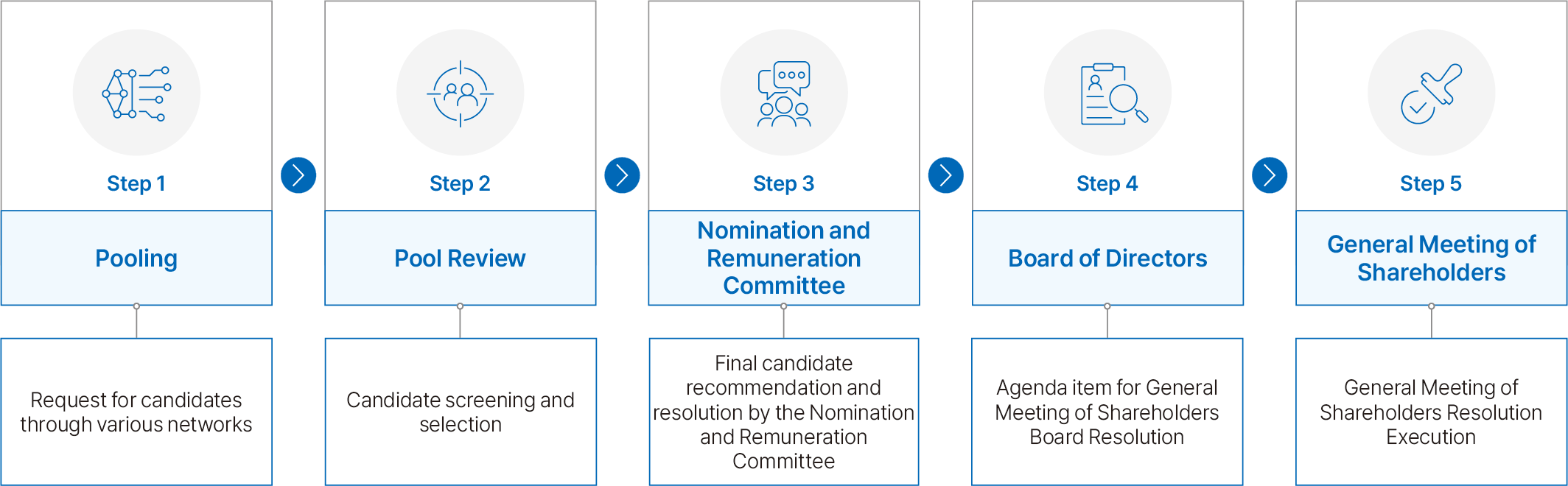
SK ecoplant considers the principles of independence, expertise, and diversity when nominating independent directors. Following the formation of a candidate pool*, the Board reviews its current competency profile and identifies additional capabilities required to shortlist first-round candidates. During this process, the Nomination and Remuneration Committee ensures independence and fairness by excluding individuals with potential conflicts of interest from the candidate pool. Recommended candidates are then asked to sign a qualification confirmation form verifying their eligibility as independent directors. Final appointments are made through Board resolution and shareholder approval. Going forward, SK ecoplant will continue to assess the Board’s composition and capabilities holistically to ensure an independent and effective governance structure, and aims to appoint professionals in line with global standards over the mid- to long-term.
* Independent Director candidate pool: Individual recommenders, management recommenders, Governance Council recommenders, and external search firm recommenders
Independent Director Nomination Process
Board Diversity
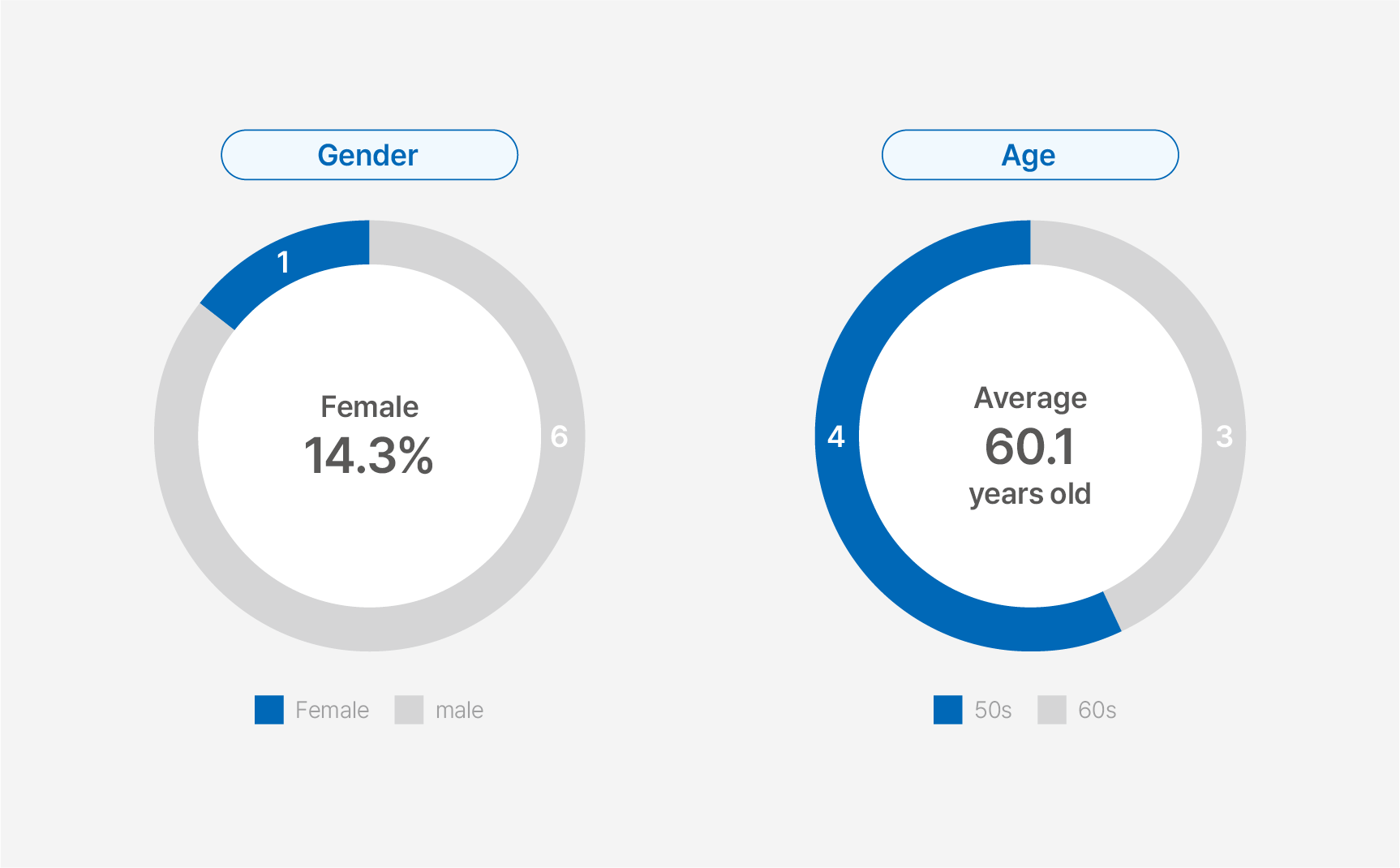
SK ecoplant ensures diversity within the Board of Directors to review potential risks and opportunities from multiple perspectives, leveraging varied experiences and expertise throughout its business portfolio expansion. In December 2022, a female global HR expert was appointed as an independent director. Moving forward, SK ecoplant will continue to enhance the Board’s diversity by considering a range of factors in director appointments, including gender, age, race, nationality, country of birth, and cultural background. Furthermore, the company will appoint experts in various fields as Independent Directors based on the BSM (Board Skills Matrix) to further bolster Board diversity and expertise.
Board Diversity Status
Board Expertise
In expanding its business portfolio, SK ecoplant appoints directors with the expertise and practical experience necessary for sound decision- making, considering a wide range of competencies such as business strategy, ESG, and global competency. To ensure a structured and objective nomination process, internal criteria have been established for evaluating expertise across key domains. The Board’s competency profile, assessed based on these criteria, is disclosed transparently to internal and external stakeholders in tabular format. In March 2025, to strengthen change management following the reorganization of the business portfolio, Independent Director Mira Lee was reappointed. In January 2026, to strengthen the management and oversight of legal risks in accordance with amendments to the Commercial Act, Independent Director Il-Hwan Kim, a legal expert, was newly appointed. And in March, Independent Director Jae-Cheol Kim, a finance and accounting expert, was newly appointed to strengthen the management and oversight of financial risks.
Board Competency Profile
Name | Leadership | Finance, Accounting, and | M&A and | Business | ESG | Industry and Technology | Global |
|---|---|---|---|---|---|---|---|
Dong-Hyun Jang | ● | ● | ● | ● | |||
Young-Sik Kim | ● | ● | ● | ● | ● | ||
Mira Lee | ● | ● | ● | ● | |||
Yeon-Man Jeong | ● | ● | ● | ● | |||
Il-Hwan Kim | ● | ● | ● | ● | |||
Jae-Cheol Kim | ● | ● | ● | ● | |||
Kee-Dong Kim | ● | ● | ● | ● |
Competency Classification Criteria by Area
Area | Detailed Competency Criteria |
|---|---|
Leadership | Possesses expertise required for managing large-scale organizations |
Finance, Accounting, and Risk | Holds professional knowledge in finance and accounting necessary for corporate management |
M&A and Investment | Demonstrates expertise in corporate investment activities such as M&A and IPOs |
Business Strategy | Has experience and expertise in business strategy, transformation, and portfolio management |
ESG | Holds professional knowledge in environmental, social, and governance (ESG) matters |
Industry and Technology | Possesses experience and engineering credentials relevant to future growth sectors such as the |
Global Competency | Has experience in executing global business operation |
Independent Director Expertise Training
SK ecoplant provides regular training programs to strengthen the expertise and improve the operational efficiency of independent directors, and actively participates in capability-building sessions organized by the SK Group. All members of the Audit Committee also attend at least one audit committee forum or external training program offered by accounting firms annually to enhance audit-related expertise. In 2025, the company held a total of six training sessions covering topics such as business portfolio restructuring strategies in response to internal and external environmental changes, as well as the current state of the AI and semiconductor industries and the global economy. Participants also visited relevant domestic sites to deepen their business understanding. Detailed information regarding the status of training programs for Independent Directors is transparently disclosed in the annual business report.
Board Activities and Evaluation
Board Activities
In accordance with its Board Regulations, SK ecoplant holds regular Board meetings during the last week of each month, and convenes ad hoc meetings or sessions exclusively for independent directors when necessary. To ensure efficient meetings and meaningful discussions, notifications are issued seven days prior to each meeting, and relevant materials are shared in advance. Individual directors are also briefed beforehand when needed to ensure they are well-informed. In 2025, the Board held a total of 19 meetings, during which 101 resolutions and 21 reporting items were deliberated. The average attendance rate of independent directors in 2025 was 98%, with no objections or abstentions recorded on any resolutions.
Supporting and Ensuring Directors’ Activities
SK ecoplant guarantees the execution of directors’ duties through formal internal regulations. In cases where a director faithfully fulfills their duty of care as a prudent manager, liability may be reduced through an ordinary resolution of the general shareholders’ meeting in accordance with Article 31, Paragraph 2 of the Articles of Incorporation. However, this liability reduction does not apply in cases of willful misconduct, gross negligence, or violations under Articles 397 and 398 of the Commercial Act. To further ensure the independence of directors and management, Directors and Officers (D&O) Liability Insurance is renewed annually. Additionally, pursuant to Article 13, Paragraph 2 of the Board Regulations, the company provides external expert consultation and support at its own expense upon request by a director.
Discussion of ESG Agenda Items
The Board of Directors actively discusses ESG agenda items through the activities of the Board and its specialized committees. The Board of Directors, Audit Committee, and Nomination and Remuneration Committee discuss initiatives to improve ethical management, occupational safety and health, and corporate governance, while the Strategy and ESG Committee reviews ESG management-related matters such as human rights management, environmental management, and climate change response. In 2025, the Board and Strategy and ESG Committee addressed a total of 27 ESG agenda items.
ESG Agenda Decision-Making
Committee | Date | ESG Agenda Item | Resolution |
|---|---|---|---|
Board of Directors | Feb. 10, 2025 | 2025 Safety and Health Plan (2024 Performance and 2025 Plan) | Approved |
Report on the 2024 Internal Control over Financial Reporting Operations | Reported | ||
Amendment to the Internal Control over Financial Reporting Operations | Reported | ||
Mar. 6, 2025 | Committee Modification/Establishment | Approved | |
Amendment to the Articles of Incorporation | Approved | ||
Report on the Evaluation of 2024 Internal Control over | Reported | ||
Report on 2025 Compliance Program Plan | Reported | ||
Mar. 26, 2025 | Appointment of Committee Members | Approved | |
Amendment of Regulations | Approved | ||
Jun. 26, 2025 | Renewal of Directors and Officers (D&O) Liability Insurance | Approved | |
Impact of the New Administration on the Company | Reported | ||
Nov. 27, 2025 | Amendment to the Articles of Incorporation | Approved | |
Report on SPC Liquidation for BADAENERGY’s Floating | Reported | ||
Report on 2025 Compliance Operations | Reported | ||
Dec. 22, 2025 | Appointment of CEO | Approved | |
Board of Directors | Dec. 22, 2025 | Appointment of Committee Members | Approved |
Establishment of Compliance Guidelines | Approved | ||
Appointment of Compliance Officer | Approved | ||
Appointment of a “Chief Compliance Officer” for the Fair | Approved | ||
Report on the 2026 Management Plan | Reported | ||
Strategy and | Feb. 10, 2025 | Report on the Direction of the 2024 Board Evaluation | Reported |
Mar. 6, 2025 | Report on the Results of the 2024 Board Evaluation | Reported | |
Apr. 24, 2025 | Status of SV Monetization and Stakeholder Communication | Reported | |
Jun. 26, 2025 | Merger of Singapore-Based Subsidiaries, etc. | Reported | |
Oct. 29, 2025 | Results of Materiality Assessment | Reported | |
Status of Climate Crisis Response | Reported | ||
Status of Environmental Management | Reported |
Board Committee Activities
SK ecoplant operates a Strategy and ESG Committee, Nomination and Remuneration Committee, and Audit Committee under its Board of Directors. The Nomination and Remuneration Committee also performs the functions of the Independent Director Nomination Committee and Compensation Committee, while the Audit Committee fulfills the role of the Internal Transaction Committee. Key agenda items and activities discussed by each committee are regularly reported to the Board during the corresponding month.
Status of Board Committees
Committee | Key Functions | Committee Composition | Chair | Supporting Organization |
|---|---|---|---|---|
Strategy and |
| One Inside Director Four Independent Directors One Non-Executive Director | Yeon- | Responsible Departments by Agenda Item and |
Nomination and Remuneration |
| Two Independent Directors One Non-Executive Director | Mira Lee | HR Department and |
Audit |
| Three Independent Directors (Jae-Cheol Kim, Mira Lee, | Jae- | Finance Department, |
Strategy and ESG Committee
In March 2025, SK ecoplant renamed the ESG Committee to the Strategy and ESG Committee to strengthen its role in reviewing mid- to long-term strategies. The Strategy and ESG Committee operates with the goal of establishing a transparent and sustainable management system. It is responsible for formulating the company’s mid- to long-term ESG strategies, discussing governance improvement measures, and reviewing key ESG issues and performance areas such as human rights and occupational safety and health. The committee also identifies financial and non- financial risks and opportunities related to climate change and develops response strategies. Additionally, it performs an investment review function for significant investment decisions. Furthermore, it continuously seeks ways to enhance social value in response to evolving internal and external business environments. In 2025, the committee convened five times, deliberating on a total of nine agenda items, including one related to strategy, two to environment, one to society, and five to governance. The average attendance rate in 2025 was 93%, with no objections or abstentions recorded on the two resolution items.
Nomination and Remuneration Committee
The Nomination and Remuneration Committee was established in 2021 through the integration of the Independent Director Nomination Committee and the Compensation Committee. Accordingly, it performs the functions of both predecessor committees, including recommending final candidates for independent directors to be appointed at the general shareholders’ meeting and reviewing and approving individual compensation for inside directors. The committee also evaluates the performance of the CEO and deliberates on matters such as the granting of stock options to both registered and non-registered executives. In 2025, the committee convened six times, deliberating and resolving a total of 12 agenda items, including recommendations for new independent director and CEO candidates, evaluation of CEO activities, and internal director compensation resolutions. The average attendance rate for the committee in 2025 was 94%. Among the six resolution items, there were no objections or abstentions.
Audit Committee
The Audit Committee serves as the oversight body for internal ethics and anti-corruption practices, exercising broad supervisory authority over related functions. It independently evaluates the operation of the internal control over financial reporting and monitors the performance of individual directors. It also conducts prior reviews of internal transactions and inter-affiliate dealings, and holds the authority to consent to the appointment and dismissal of the head of the internal audit department, as well as to review and approve performance evaluations—ensuring effective oversight.
To maintain independence, SK ecoplant has composed the three Audit Committee members entirely of independent directors, and as of March 2026, appointed one financial/accounting expert and one industry specialist to enhance audit effectiveness. To support the committee’s operations, dedicated support teams have been established within both the finance and internal audit departments. In February 2024, the internal audit organization was restructured to report directly to the Audit Committee, further reinforcing its independence. In 2025, the Audit Committee held a total of 14 meetings and deliberated and resolved 55 items, including 12 related to internal accounting control, 9 on financial statement audits, 13 general audit items, 11 other major audit matters, and 10 prior reviews of internal transactions. The average attendance rate of committee members in 2025 was 100%, with no objections or abstentions recorded among the five resolution items.
Since 2023, SK ecoplant has implemented a procedure requiring prior approval from the Audit Committee for all non-audit services performed by the external auditor. Through this process, all non-audit service contracts are reported and discussed with the Audit Committee in advance, and contract details are transparently disclosed through the business report. Additionally, to safeguard auditor independence, quarterly pre-meeting sessions are held between the Audit Committee and the external auditor, ensuring ongoing institutional efforts.
Audit Training Status
Training Date | Training Organizer | Key Training Topics |
|---|---|---|
May 28, 2025 | Audit Committee Forum |
|
Jul. 1, 2025 | KPMG Samjong Accounting Corp. |
|
Sep. 30, 2025 | Financial Planning Team |
|
Oct. 21, 2025 | Audit Committee Forum |
|
Dec. 12, 2025 | Audit Committee Forum |
|
CASE | Strengthening the Audit Committee’s Role in Reviewing Internal Transactions |
|---|
In accordance with Article 9 (Functions and Authority) of the Audit Committee Regulations, the Audit Committee oversees and manages inter-affiliate transactions and related-party transactions, serving as the primary body for prior review of internal transactions. For related-party transactions requiring Board approval under the Monopoly Regulation and Fair Trade Act, the committee conducts prior reviews to enhance the procedural legitimacy and independence of Board resolutions.
Status of Prior Review of Internal Transactions
Date | Agenda Item | Attendance/Eligibility |
|---|---|---|
May 8, 2025 | Execution of Third-Party Allotment Capital Increase | 3/3(100%) |
Execution of a Comprehensive Share Swap Agreement and Setting of the Record Date | 3/3(100%) | |
Aug. 18, 2025 | Business Acquisition | 3/3(100%) |
Acquisition of FI Shares | 3/3(100%) | |
Aug. 22, 2025 | Amendment to Third-Party Allotment Capital Increase (In-Kind Contribution) Conditions | 3/3(100%) |
Amendment to the Comprehensive Share Swap and Setting of the Record Date | 3/3(100%) | |
Oct. 29, 2025 | Approval of Large-Scale Internal Transaction with SK airplus Inc. | 3/3(100%) |
Nov. 13, 2025 | Sale of renewenergy Chungbuk | 3/3(100%) |
Dec. 22, 2025 | Large-Scale Internal Transaction of Goods and Services with SK Inc. | 3/3(100%) |
Large-Scale Internal Transaction of Goods and Services with Bloom SK Fuel Cell | 3/3(100%) |
Board Evaluation
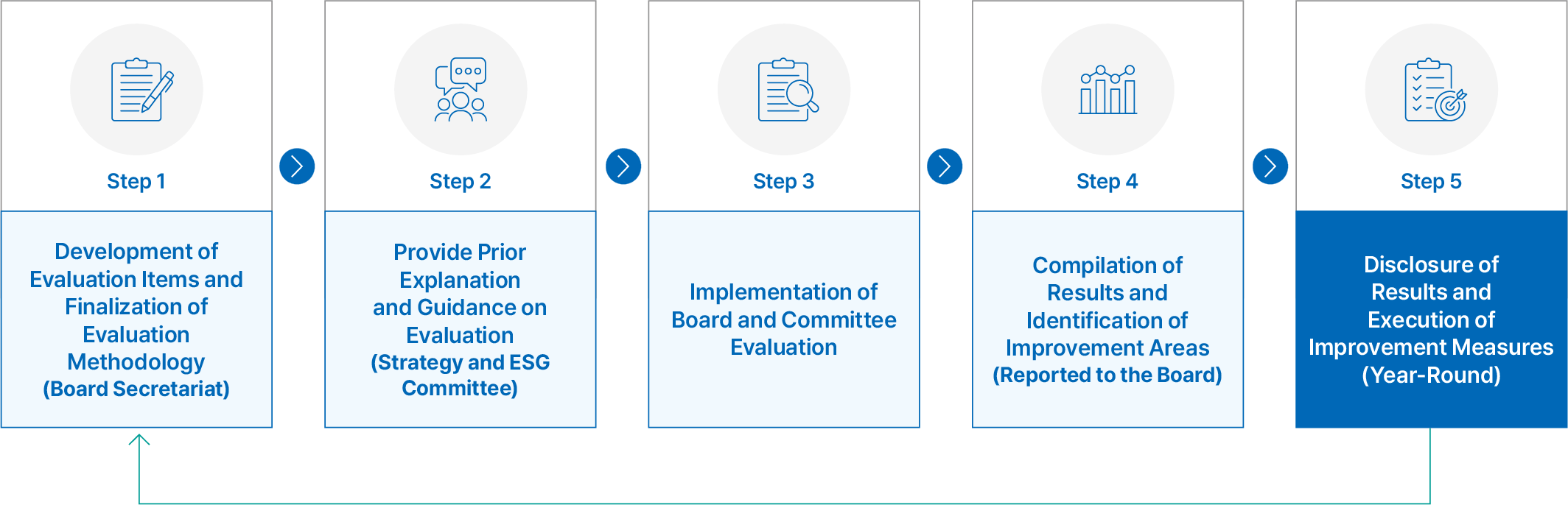
SK ecoplant conducts an annual board evaluation to continuously improve the operational performance of the Board of Directors and its committees. In principle, this self-assessment—administered by the Board Secretariat—consists of both multiple-choice and open-ended questions. Prior to evaluation, the Board and each committee are informed of the purpose, methodology, scope, and evaluation criteria. Furthermore, the evaluation process includes assessments of the Board, its specialized committees, individual directors (self-assessment and peer review), and management, all rated on a 5-point scale (1: Very Poor to 5: Excellent). The results are reported annually to the Board or Strategy and ESG Committee to assess the overall status of the Board’s operations, after which improvement measures are developed and implemented.
In 2025, the Strategy and ESG Committee shared the direction for the board evaluation and reported results to the Board. Based on this, in 2026, SK ecoplant plans to supplement discussions on SK ecoplant’s short-, medium-, and long-term strategies and implement programs to strengthen the Board’s professional capacities. Going forward, the company aims to refine the evaluation criteria and diversify the evaluators to enable the implementation of a “shareholder evaluation,” in which major shareholders evaluate the Board, as well as a “Board Chair Evaluation” (to be implemented after separation of the inside director and Board Chair roles). Additionally, Board evaluation results will be transparently disclosed on the company’s website or in annual business reports.
Board Evaluation Process
Board Evaluation Criteria
Category | Roles and | Operations | Independence | Integrity | Understanding | Contribution |
|---|---|---|---|---|---|---|
Board of Directors (35 questions) | ● | ● | ||||
Committees under the Board | ● | ● | ||||
Individual Director Self-Assessment | ● | ● | ● | ● | ||
Peer Evaluation of Individual Directors | ● | ● | ● | ● | ||
Management Evaluation (35 questions for | ● | ● |
Director Compensation Policy
At the beginning of each year, the Nomination and Remuneration Committee receives reports on executive activity plans and conducts a final review of inside directors’ performance evaluations at year-end. The executive compensation system is established and revised following reports to the Nomination and Remuneration Committee. Based on this system, individual compensation levels for inside directors are reviewed in accordance with their performance evaluations. The Board resolves the individual compensation amounts for inside directors and submits the total compensation limit for all directors to the general shareholders’ meeting for approval.
Both financial and non-financial performance are considered when calculating director compensation, with the criteria for compensation payments being transparently disclosed in the annual business report. Non-financial performance includes factors such as the achievement of strategic goals, leadership, progress toward net-zero, the level of ESG management, and happiness-oriented and ethical management. Non-financial performance and goals are also reflected at a certain minimum percentage when establishing KPIs for the entire executive team, including the CEO.
Shareholder-Friendly Management
Protection of Shareholder Rights
SK ecoplant is committed to enhancing long-term shareholder value by safeguarding shareholder rights and fostering a shareholder-friendly governance environment. To improve accessibility in exercising shareholder rights, an electronic voting system has been implemented. Notices regarding the Annual General Meeting are provided via postal mail and the company website. The company also encourages active participation in voting by providing detailed instructions on how to exercise voting rights through its website. Dividends are paid in accordance with the Articles of Incorporation and are subject to resolutions by the Board of Directors and the General Meeting of Shareholders. The company’s dividend policy aims to maintain a long-term and stable level of cash dividends based on business performance. Additionally, the Articles of Incorporation formally provide the basis for interim dividends, thereby establishing a foundation for enhancing shareholder value. Going forward, the company intends to maintain a balanced approach between investments for future growth and shareholder return policies, based on a comprehensive assessment of market conditions and financial standing.
Matters Resolved at the General Meeting of Shareholders
SK ecoplant follows the principle of one voting right per share. As of the end of March 2026, there were 64,659,748 shares with voting rights, accounting for approximately 98.6% of all issued shares; the company has also issued a limited number of non-voting preferred shares.
Voting Rights Status (as of the end of March 2026)
Category | No. of Shares (shares) | Shareholding Ratio (%) |
|---|---|---|
Shares with Voting Rights | 64,659,748 | 98.6 |
Shares without Voting Rights | 940,000 | 1.4 |
Total No.of Issued Shares | 65,599,748 | 100 |
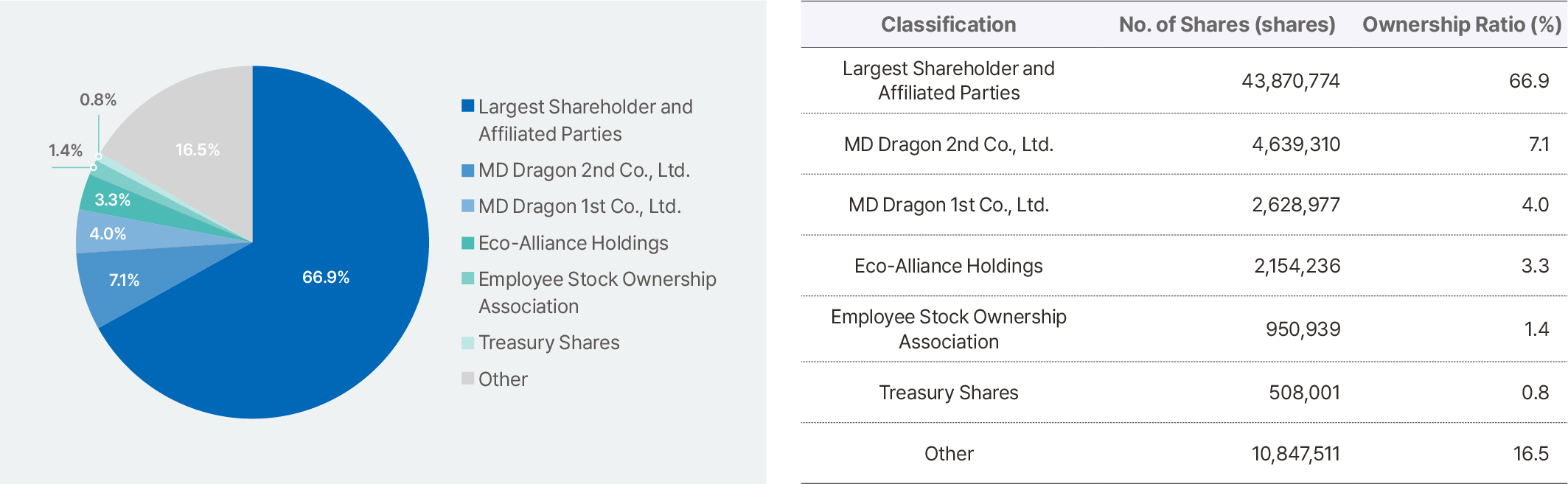
Shareholder Ownership Status (as of the end of March 2026)