Governance
Supply Chain Management Policy
SK ecoplant aims to create social value by fulfilling its environmental and social responsibilities based on strong partnerships with its Biz. Partners. To this end, the company operates financial and non-financial shared growth programs designed to strengthen the competitiveness of its Biz. Partners. Additionally, to fulfill its environmental responsibilities in the raw material procurement process, SK ecoplant actively identifies Biz. Partners that manufacture and sell eco-friendly products, thereby expanding its eco-friendly procurement efforts. The company also operates a supply chain ESG evaluation system to improve Biz. Partners’ ESG management standards and proactively identify and address potential ESG risks. In 2024, SK ecoplant established a Supply Chain Management Policy outlining the principles for building this sustainable supply chain ecosystem, which is mandatory for all Biz. Partners.
SK ecoplant outlines operational practices for Biz. Partners through its “Code of Conduct for Biz. Partners.” The Code of Conduct for Biz. Partners is based on global guidelines such as the UN Universal Declaration of Human Rights, the 10 Principles of the UN Global Compact, and the International Labor Organization (ILO)’s “Declaration on Fundamental Principles and Rights at Work,” and sets out detailed guidelines that Biz. Partners must adhere to in various areas, including human rights, labor, safety, health, the environment, corporate ethics, and the lawful procurement of raw materials. The Code of Conduct for Biz. Partners encourages active participation in ESG management by requiring Biz. Partners to sign and commit to complying with the Code of Conduct within the Total Materials Management System (TOMMS) upon registration as an SK ecoplant Biz. Partner.
Supply Chain Management Governance
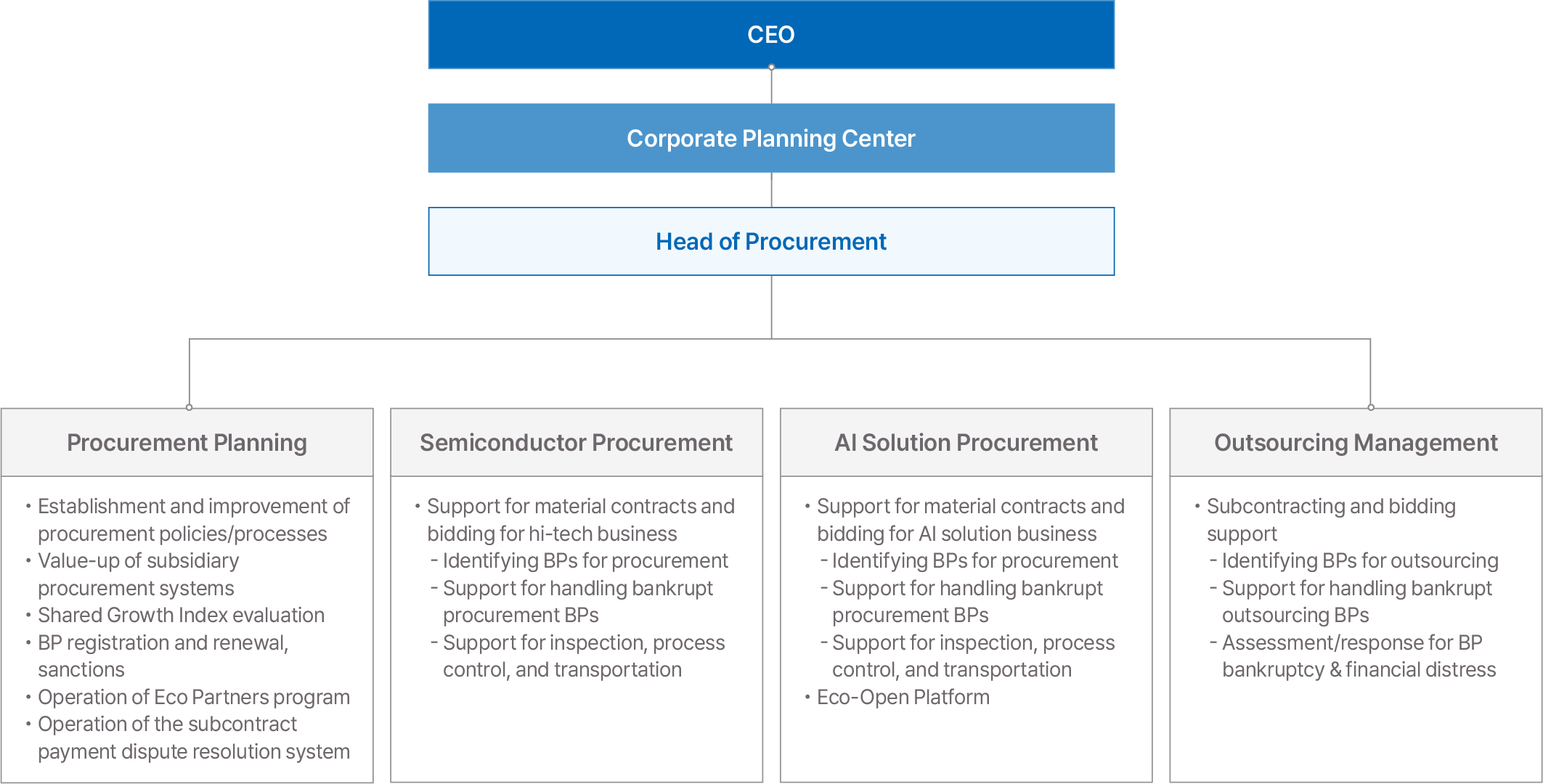
SK ecoplant is establishing and implementing a supply chain management system centered on the Head of Procurement under the Corporate Planning Center, in collaboration with relevant departments. To ensure stable supply chain operations and sound business execution, the company manages financial management indicators related to Biz. Partner contracts and Shared Growth Index evaluation ratings in conjunction with KPIs.
Supply Chain Management Organizational Chart
Strategy
Identifying and Assessing Supply Chain Management Risks and Opportunities
SK ecoplant identifies and assesses key supply chain management risks and opportunities expected to impact its business operations. By understanding their implications across the entire business and value chain, the company incorporates these findings into its supply chain management strategy. Through this process, SK ecoplant manages supply chain management risks, while identifying company-wide initiatives and site-specific tasks to drive effective improvement activities.
Impact on Business and the Value Chain
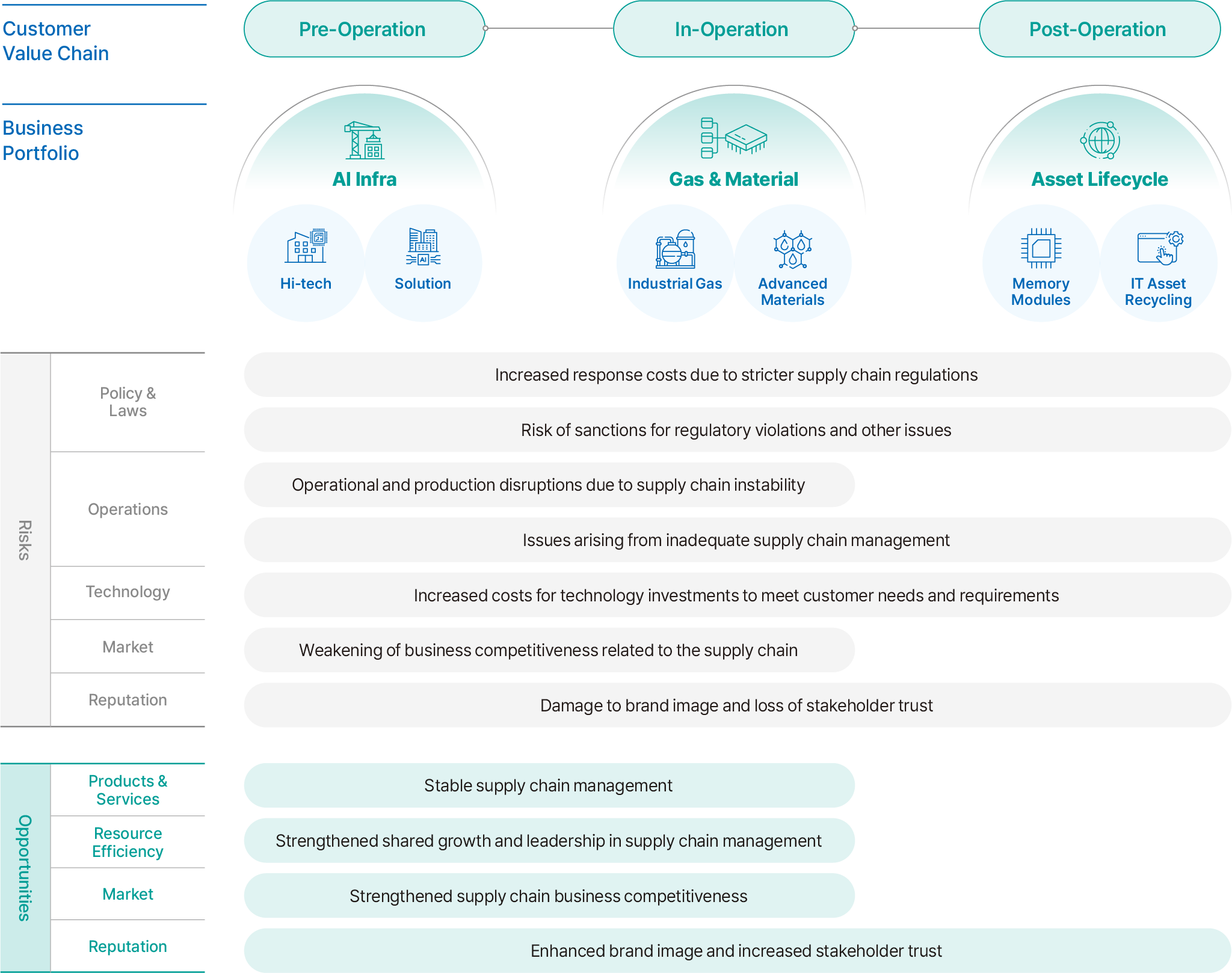
Key Risks and Opportunities
Category | Risks and | Business and Financial | Timing of Maximum | Response Strategy | |||
|---|---|---|---|---|---|---|---|
Short-term (up to 1 year) | Medium term | Long- | |||||
Risks | Operations | Supply and demand |
| ● | ● | ● |
|
Supply issues arising from a single product or supplier (stock | ● | ● | ● | ||||
Inadequate monitoring and management of |
| ● | ● | ● |
| ||
Technology | Increasing customer needs and demands, as well as competitors’ response efforts |
| ● | ● |
| ||
Opportunities | Products & Services | Securing long-term |
| ● | ● | ● |
|
Resource | Enhancing Biz. |
| ● | ● |
| ||
Strategies for Addressing Key Risks and Opportunities
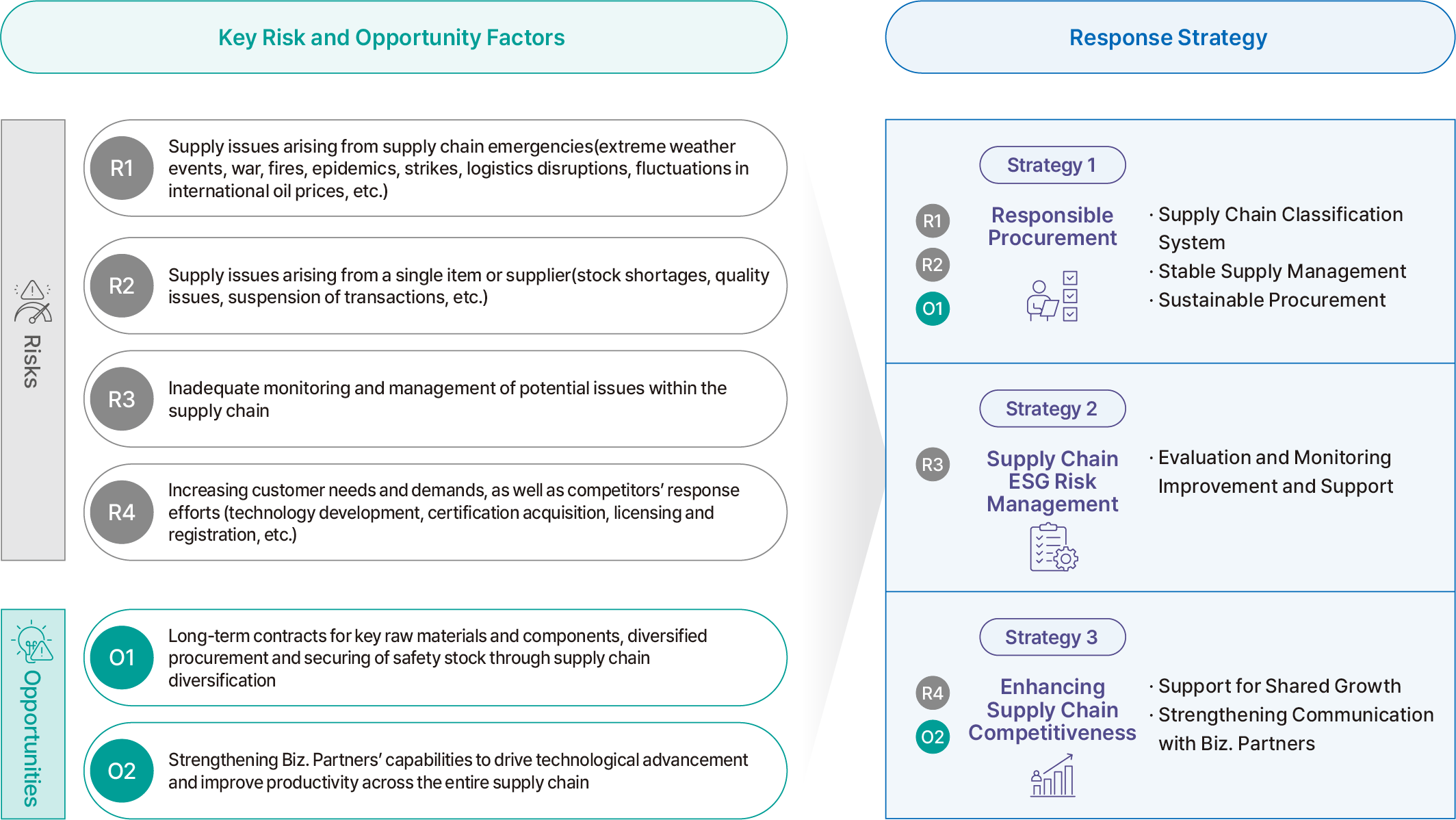
Strategy 1. Responsible Procurement
SK ecoplant strives to ensure stable and responsible procurement by minimizing supply chain risks that may arise during the purchasing and procurement processes, based on transparent and fair transactions with Biz. Partners. To this end, the company identifies and manages core Biz. Partners through a supply chain classification system, while conducting Biz. Partner evaluations and support activities based on a purchasing strategy that considers potential risks within the supply chain and their business impact.
SK ecoplant establishes procurement plans for eco-friendly products and manages their performance. To prevent the use of raw materials obtained through unethical means, “prohibition on the use of conflict minerals” has been explicitly stipulated in the Code of Conduct for Biz. Partners (Chapter 6, Article 34). SK ecoplant’s Biz. Partners are required to conduct responsible procurement activities—including policy formulation, system establishment, and due diligence—throughout the entire mineral procurement process, in accordance with their obligation to comply with the Code of Conduct for Biz. Partners, to which they voluntarily agreed upon signing the procurement contract.
Supply Chain Classification System
SK ecoplant identifies and evaluates core Biz. Partners through a supply chain classification system that takes into account strategic procurement importance and ESG risks, and then manages them on an ongoing basis. Core Biz. Partners are primarily selected from among the member companies of “ECO Partners,” SK ecoplant's consortium of contracted companies, and are chosen based on a comprehensive review of transaction volume, core work categories, and the level of cooperation.
Furthermore, the evaluation process for selecting Biz. Partners incorporates not only financial and management assessments, capability evaluations, and on-site inspections but also criteria related to sustainable management performance, such as safety and quality. Biz. Partners with ESG evaluation results receive preferential treatment during the annual registration and renewal process, while those with a history of safety incidents or other accidents are subject to penalties during the selection evaluation.
Stable Supply Management
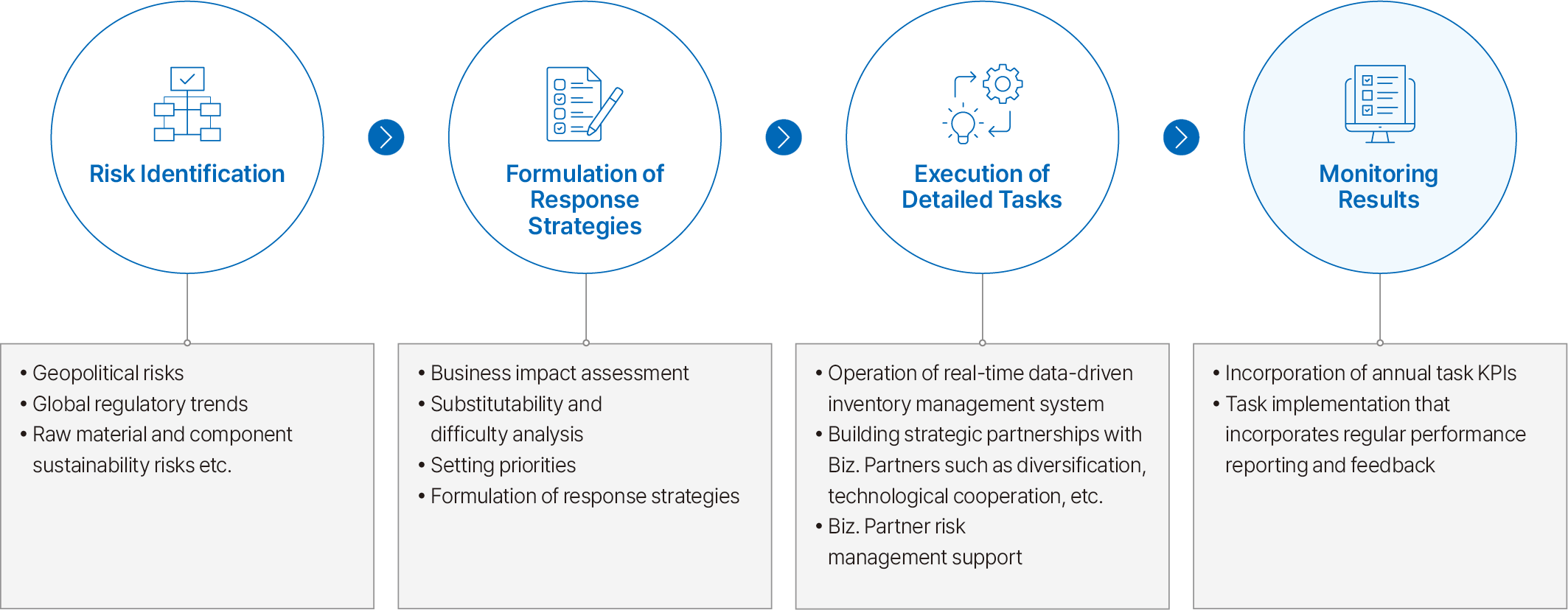
SK ecoplant manages emergency situations, ESG issues, and supply and demand issues caused by a single item or supplier. The company periodically monitors fluctuations in overall market supply and demand caused by external issues such as war, fire, epidemics, strikes, logistics disruptions, fluctuations in international oil prices, and extreme weather events. Stable supply is maintained through integrated procurement, an annual unit pricing system, and multiple supply chains.
Sustainable Procurement
SK ecoplant has established an Eco-friendly Procurement Policy to formalize operational standards for expanding the purchase of eco-friendly products and aggregating related performance data. Eco-friendly products are defined based on relevant laws concerning energy, environmental technology, resources, and recycling, and monthly purchase volumes are aggregated through the company’s integrated procurement system. To further expand green procurement, designated personnel have been assigned to oversee eco-friendly purchasing, and the discovery of eco- friendly materials and purchase performance have been set as key performance indicators for members of the relevant departments. Regular training on green procurement is also provided to procurement staff and related departments. In addition, incentives are offered to Biz. Partners that manufacture and sell eco-friendly products. In 2025, approximately KRW 158.6 billion worth of eco-friendly products were procured, and the scope of applicable items will continue to be expanded.
CASE | Subsidiaries’ Efforts to Ensure Supply Chain Stability |
|---|
SK ecoplant’s subsidiaries—SK materials performance, SK trichem, SK resonac, and SK materials jnc—are ensuring supply chain stability through strategies such as supply chain diversification, identifying alternatives to scarce resources, and optimizing inventory management. They are diversifying the supply chain by expanding sourcing from third countries and adding suppliers within the same country, while localizing key raw materials. They also continuously identify and adopt alternative materials, including recycled materials, to reduce reliance on scarce resources. Furthermore, subsidiaries are enhancing inventory operations and management by diversifying logistics routes—such as adding export and import ports—and utilizing external warehouses for the efficient management of safety stock. In addition, they conduct weekly inspections of raw material inventories and hold company-wide production and sales meetings every other week to discuss safety stock management and operational strategies.
Supply Chain Stability Implementation Process
Strategy 2. Supply Chain ESG Risk Management
Supply Chain ESG Evaluation
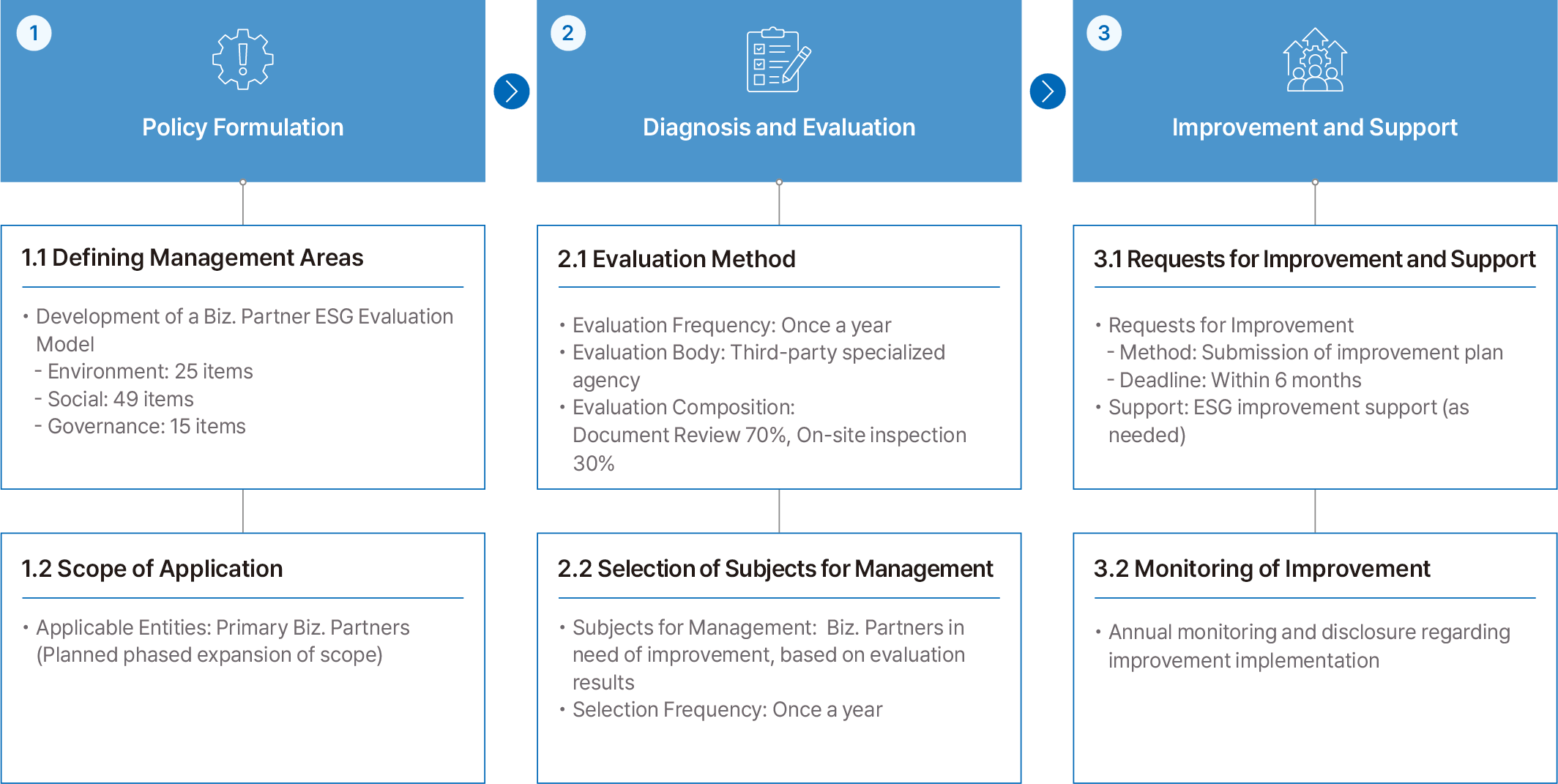
SK ecoplant operates the “Supply Chain ESG Evaluation and Improvement Support Program,” developed in collaboration with major credit rating agencies to strengthen ESG management and manage supply chain risks. Through this program, SK ecoplant conducts annual ESG evaluations and on-site inspections by external evaluation agencies for core as well as newly registered Biz. Partners, and provides financial support to encourage active participation. In particular, to build a supply chain centered on Biz. Partners with competitiveness and ESG management capabilities amid a changing business environment, the company encourages core Biz. Partners to voluntarily participate in ESG evaluations.
Furthermore, during the Biz. Partner selection evaluation, SK ecoplant considers not only financial and management assessments, capability evaluations, and on-site inspections but also items related to sustainable management performance, such as safety and information security. Biz. Partners with ESG evaluation results receive preferential treatment during the annual Biz. Partner registration and renewal process, while those with a history of accidents—such as safety incidents—are penalized. Furthermore, to enable leadership to review and manage issues related to supply chain sustainability, the Corporate Planning Center and relevant executives monitor and support the supply chain ESG evaluation results, risk levels, and follow-up actions.
Supply Chain ESG Evaluation and Improvement Support Program
Supply Chain ESG Evaluation Criteria
Category | Evaluation Elements | Evaluation Items |
|---|---|---|
Environment | Environmental | Environmental strategy, environmental management, environmental performance, environmental governance, etc. |
Social | Occupational Safety | Appointment of safety managers, occupational safety and health management policies and objectives, operation of the occupational safety and health organization, site-specific risk assessments, CEO’s safety initiatives, on-site occupational safety and health inspections, management systems for hazardous substances and equipment, occupational safety and health training, emergency response, channels for gathering feedback from on-site workers, provision of personal protective equipment, certification of the occupational safety and health management system, occupational safety and health investment, etc. |
Labor | Compliance with legal standards for employment contracts, compliance with the Labor Standards Act, workers’ employment environment, operation of labor unions and labor-management councils, labor rights, employment of vulnerable groups, training management, etc. | |
Quality | Sustainable supply management, etc. | |
Governance | Shareholders | Status of largest shareholders, etc. |
Management Systems | Ethical management (anti-corruption and compliance, etc.) training, regulations on the anti-corruption whistleblower reporting system, regular internal audits, regulations on the collection, storage, and processing of personal data, as well as information security, etc. |
Support for Supply Chain ESG Improvement
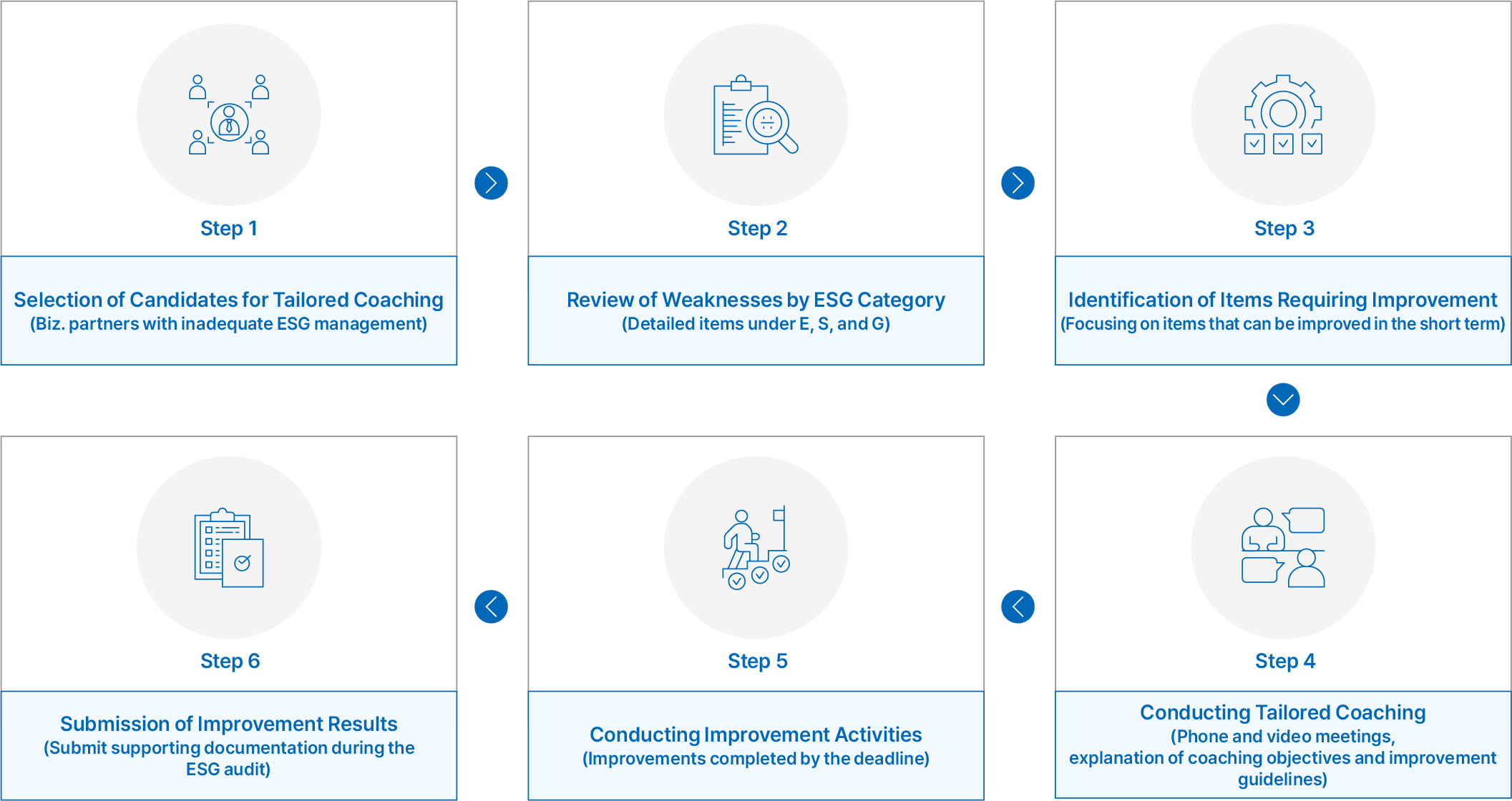
Following Biz. Partner ESG evaluation, SK ecoplant uses its ESG Value-up Program to monitor the establishment and implementation of improvement tasks across all areas—including ESG policies, organizational structure, and training operations—and provides support for improvement activities as needed. Based on an analysis of performance levels across each ESG category, the company conducts one-point coaching, on-site guidance, and online briefings for areas of needing improvement, while checking improvement task implementation status through the year-round ESG Help Desk. In particular, for Biz. Partners whose ESG evaluation results and management are insufficient, SK ecoplant operates tailored coaching programs to support practical capacity building. Starting in 2025, as part of efforts to strengthen Biz. Partners’ ESG capabilities, the company has introduced ESG consulting services provided by external specialized agencies. Additionally, to enhance the provision of ESG information to Biz. Partners, SK ecoplant produces and distributes the quarterly ESG newsletter, “Eco ESG Bridge.”
Biz. Partner ESG Value-up Program
Category | Support Details | Support Methods |
|---|---|---|
Organization and Policy |
|
|
Training |
|
|
Provision of Information |
|
|
Tailored Coaching Process for Biz. Partners
Strategy 3. Enhancing Supply Chain Competitiveness
SK ecoplant operates a variety of financial and non-financial shared growth support programs, such as fair subcontracting practices and joint technology development support, to strengthen collaboration with Biz. Partners and enhance the overall competitiveness of the supply chain. Since the second half of 2023, a cooperative model has been established with the Korea SMEs and Startups Agency, and in February 2024, practical training was conducted to help prepare for the Serious Accidents Punishment Act, which has been expanded to apply to workplaces with fewer than 50 employees. As a result of these collaborative efforts, SK ecoplant was recognized as the industry’s first company to be designated as an “Honorary Excellent Company” for nine consecutive years in the Shared Growth Index evaluation hosted by the Korea Commission for Corporate Partnership. As a leading shared growth enterprise, SK ecoplant plans to further systematize implementation plans for each support program and gradually expand the scope of eligible beneficiaries.
Shared Growth Support Programs
Category | Program | Details |
|---|---|---|
Financial | Shared Growth Loan Program | Interest-free funding support |
Shared Growth Fund | A fund jointly established by SK affiliates and IBK Industrial Bank of Korea, providing low-interest loans compared to market rates | |
Contract Performance Guarantee | Reduction in contract performance guarantee rates for Biz. Partners | |
HR & Recruitment | Recruitment Support | Support for job creation through the operation of a program to assist Biz. Partners in recruiting top talent |
Technology | Innovation Partnership Support Program | Supporting Biz. Partners’ voluntary innovation Initiatives using shared |
Support for Tech Leasing | Protect key technical data by escrowing at the Korea Foundation for | |
Training | Outsourced Trainings | Support for training costs for practical construction training courses |
Shared Growth CEO Seminar | Provide seminars to improve CEO capabilities of major Biz. Partners | |
Market Expansion | Participation in Sales Talks | Give opportunity to participate in various procurement consultation |
Shared Growth Mall | Operate shared growth mall to support sales channels for small and | |
Welfare and Benefits | Subsidies for Consolation and | Support for wreaths, artificial flowers, and condolence payments during |
Support for Long-Term Employment of | Encouragement of long-term employment for key personnel at Biz. | |
ESG | Support for ESG Evaluation | Support for Biz. Partners’ participation in ESG evaluations |
Biz. Partner Development Program
Since 2023, SK ecoplant has been operating the Eco Open Platform to support startups in areas such as technology development, commercialization, investment attraction, and marketing. To assist with investment attraction, the company operates a comprehensive support system covering the entire lifecycle—from startup discovery to investment and commercialization—through partnerships with organizations such as SK Securities and Korea Science & Technology Holdings. Furthermore, by securing over KRW 6 billion in government funding to expand joint technology development with Biz. Partners, SK ecoplant is contributing to the creation of a sustainable industrial ecosystem. In 2025, it is also operating a Semiconductor Open Innovation Program in collaboration with nine institutions, including KAIST and the Korea Electronics Technology Institute, to build a virtuous cycle ecosystem for the semiconductor industry.
SK ecoplant hosts annual technology competitions, such as “Tech Open Collaboration” and “ConTech Meet-Up Day,” to support the establishment of research institutes and attraction of investment for the discovery of eco-friendly innovative technologies and their commercialization. “Tech Open Collaboration” is an open technology innovation program that promotes research and development based on partnerships between established companies and startups. In 2025, the company co-hosted Tech Open Collaboration with the Korea Institute of Startup and Entrepreneurship Development and the Korea International Trade Association, and ultimately selected seven companies for “Joint R&D Projects” to identify and develop technologies necessary for business operations.
ConTech is a portmanteau of “Construction” and “Technology” and refers to innovative technologies that enhance the productivity of construction processes by leveraging Fourth Industrial Revolution technologies such as automation and digitalization. Since 2020, SK ecoplant has hosted the “ConTech Meetup Day” competition in partnership with the Korea Innovation Foundation for six consecutive years. When selecting technologies, the company comprehensively evaluates factors such as the potential for application and expansion, distinctiveness and feasibility, demand and utility, and commercial viability. In the competition held in the second half of 2025, six companies were ultimately selected for “Joint R&D Projects.”
In addition, SK ecoplant is expanding the operation of industry-specific programs, such as the Semiconductor Open Innovation Program, and strengthening the operation of platforms to foster a sustainable industrial ecosystem.
Tech Open Collaboration & ConTech Meet-Up Day
Category | Details |
|---|---|
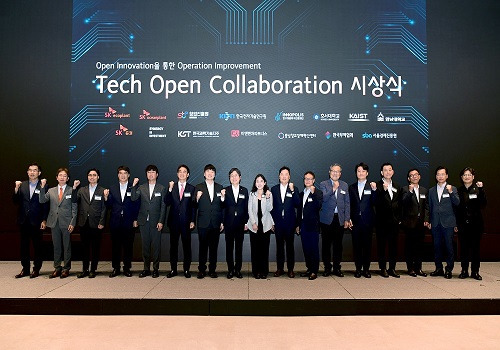 Tech Open Collaboration |
|
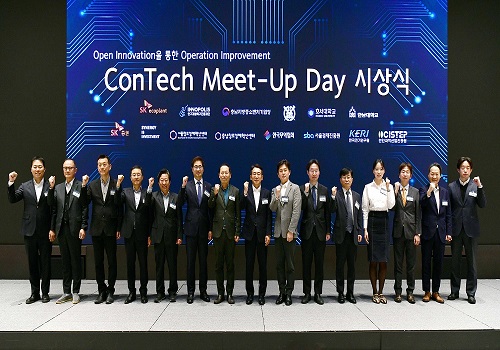 ConTech Meet-Up Day |
|
CASE | Subsidiaries’ Biz. Partner Shared Growth Activities |
|---|
SK materials performance is strengthening cooperation with Biz. Partners through technical exchange meetings covering quality, material analysis, and commercialization. In particular, the company held a total of six technical development and supply chain management exchange meetings in 2025, as well as quarterly quality exchange meetings to share information on quality issues. | |
|---|---|
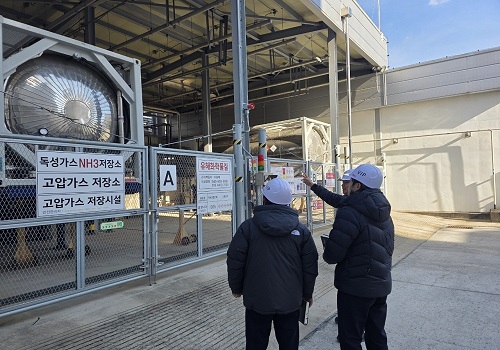 | SK trichem held monthly Occupational Safety and Health Council meetings with core Biz. Partners to gather and discuss opinions on occupational safety and health matters, such as internal safety activities and industrial accident prevention measures. Additionally, the company supports Biz. Partners with quality analysis and, through OEM and ODM models, enhances production efficiency and maximizes profits while contributing to the improvement of Biz. Partners’ production and quality capabilities. In 2025, SK airplus provided mentoring and on-site, tailored consulting to Biz. Partners whose Process Safety Management (PSM) implementation levels were insufficient. The company reviewed the status of process safety report preparation and management, in addition to providing technical support. Focusing on the 12 key elements of process safety management, it conducted on-site cross-inspections to benchmark best practices and identify areas for improvement. As a result of these improvement efforts, the company was selected as a best practice example at a workshop held by the Korea Occupational Safety & Health Agency(KOSHA)’s Chungbuk Process Safety Council. |
Strengthening Communication with Biz. Partners
SK ecoplant actively incorporates feedback from Biz. Partners into its management activities through various communication channels, such as roundtable discussions and training sessions. The company receives and addresses complaints through the “Biz. Partner Contributions” section on the dedicated Biz. Partner website, and also operates a permanent website channel for consultations and reports related to ethical business practices. Since 2023, SK ecoplant has been operating the Subcontract Dispute Mediation Committee—a settlement consultation body—to reconcile differences with Biz. Partners and resolve issues related to subcontracting payments. The Subcontract Dispute Mediation Committee convenes as needed when disputes arise and swiftly mediates conflicts between the principal contractor and the subcontractor. The committee listens to both parties, formulates a resolution plan, and proposes solutions based on mutual trust and agreement, thereby contributing to the maintenance of cooperative relationships with subcontractors.
CASE | Operation of ECO Partners |
|---|
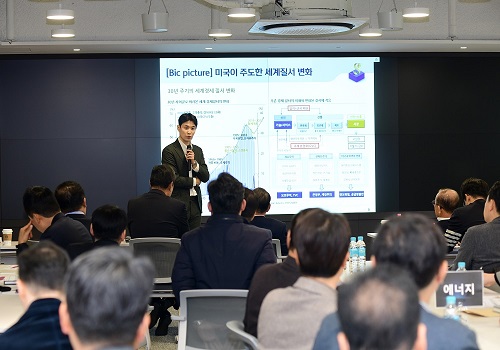 | SK ecoplant has been collaborating with Biz. Partners since launching the “Outsourcing ECO Partners” program in 2011, followed by the “Procurement ECO Partners” program in 2013. In 2025, the company held the annual general meeting of the “Outsourcing and Procurement ECO Partners” and shared insights on the outlook for the global economy and business environment, along with strategies to strengthen business competitiveness. Furthermore, to concentrate capabilities on core businesses such as comprehensive semiconductor services, energy, and the environment, and to enhance competitiveness by increasing synergy among Biz. Partners, the “ECO Partners” subcommittees were reorganized into Hi-tech, Energy, and Solution. SK ecoplant plans to continue pursuing mutual growth based on close communication with Biz. Partners. |
Risk Management
Risk Management
SK ecoplant is strengthening the competitiveness of its supply chain by minimizing potential risks through Biz. Partner selection and periodic evaluations, as well as supply chain ESG evaluations and improvement activities.
Metrics & Targets
Supply Chain ESG Management Target Roadmap
In 2025, SK ecoplant conducted ESG evaluations of 121 companies—representing 80% of all core Biz. Partners—based on evaluation criteria in the environmental, social, and governance (ESG) domains. The evaluation results identified approximately 26% of Biz. Partners as high-risk. Among these, Biz. Partners with high ESG risks or those requiring urgent improvement were selected for priority management, and their progress is being monitored. As a general principle, Biz. Partners whose ESG management levels were found to be relatively inadequate based on the evaluation results are designated as “Biz. Partners subject to priority management,” and their progress toward improvement is monitored annually. In 2025, a total of 20 companies were selected for priority management, and 100% of them implemented corrective measures.
Going forward, SK ecoplant plans to expand the scope of ESG evaluations to include 83% of core Biz. Partners in 2026, and 84% in 2027. The company aims to maintain the proportion of Biz. Partners requiring priority management due to inadequate ESG performance at 15% or below through 2025, and—reflecting overall improvements in ESG performance—to reduce this proportion to 8% or below starting in 2026. Furthermore, to strengthen Biz. Partners’ ESG capabilities, SK ecoplant conducted ESG risk evaluations for Biz. Partners in 2025 and quantitatively managed the status of improvement support provided to high-risk Biz. Partners. In 2025, the company introduced regular training for 151 core Biz. Partners, and plans to gradually expand the training content and scope starting in 2026.
Supply Chain ESG Management Status and Goals
Category | Unit | Performance | Target | ||||
|---|---|---|---|---|---|---|---|
2023 | 2024 | 2025 | 2026 | 2027 | 2028 | ||
Total No. of Biz. Partner | Companies | 1,776 | 1,965 | 1,896 | 1,896 | 1,896 | 1,896 |
No. of Core Biz. Partner1) | Companies | 324 | 324 | 151 | 151 | 151 | 151 |
No. of Biz. Partner Participating | Companies | 200 | 230 | 121 | 125 | 127 | 130 |
No. of Biz. Partner Under Priority | Companies | 30 | 35 | 20 | 10 | 11 | 11 |
1) No. of Core Biz. Partner was adjusted starting in 2025 to reflect changes in business and operational structures