ESG Management System
ESG Business Principles
In July 2022, SK ecoplant announced its Business Principles and Code of Conduct, which serve as the foundation for responsible ESG management, and is embedding ESG management into company culture through annual pledges of compliance by all employees. Moving forward, the company will continue to strengthen ESG management through systematic implementation in each key area to put sound environmental, social, and governance values into practice across all business operations.
ESG Management Governance
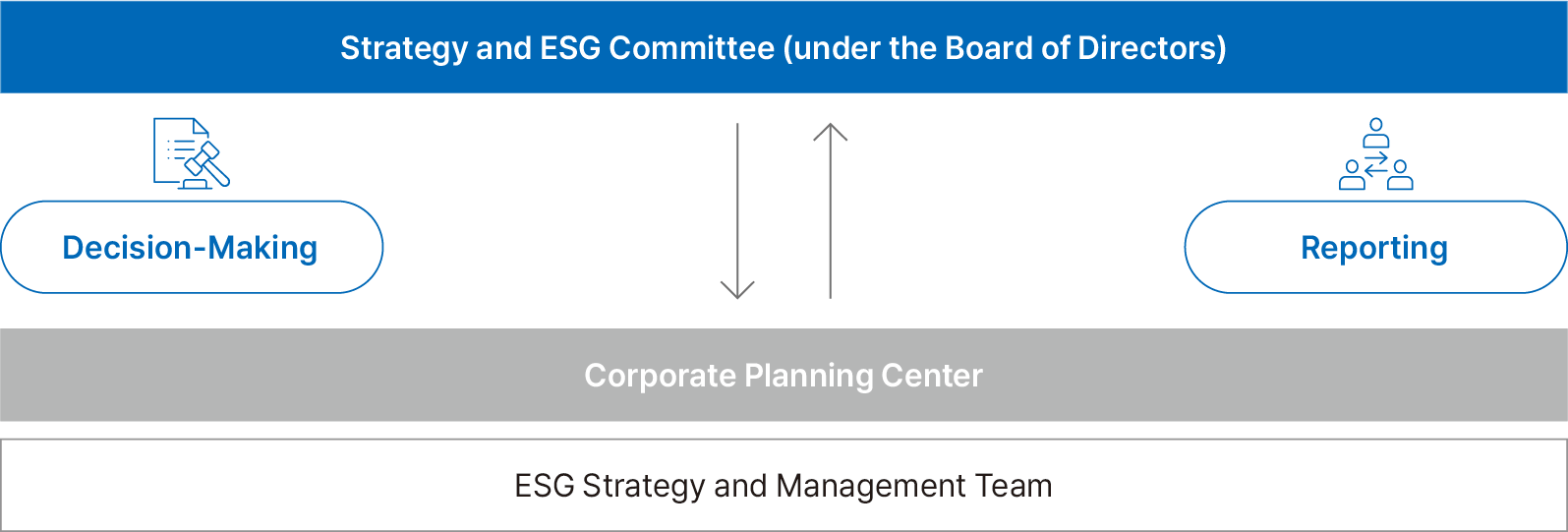
The Board of Directors and Strategy and ESG Committee (formerly the ESG Committee) formulate ESG-related strategies and make decisions based on the results of financial and non-financial risk assessments regarding key issues. The Corporate Planning Center collaborates with relevant company-wide organizations to carry out key ESG management tasks—including compliance, legal affairs, HR, PR, procurement, and corporate social responsibility—and periodically reports its work plans and performance to the Board of Directors or the Strategy and ESG Committee. In addition, the ESG Strategy and Management Team, a department directly under the Corporate Planning Center, is responsible for all operational aspects, including monitoring the implementation status of ESG management strategy execution initiatives.
ESG Management Organizational Chart
ESG Management Strategy
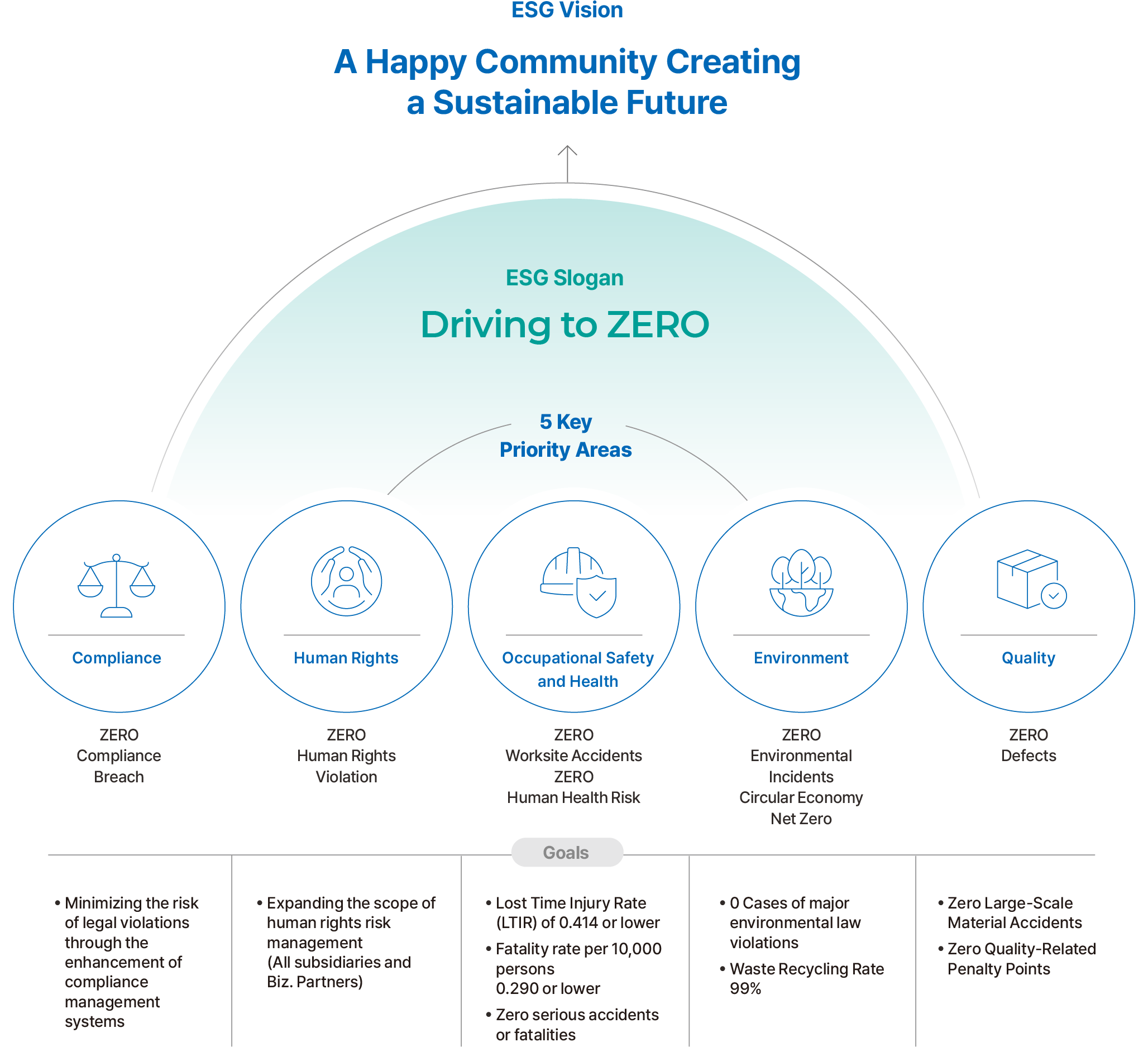
Under the vision of “a happy community creating a sustainable future,” SK ecoplant is pursuing ESG management to foster the well-being of its stakeholders. By integrating ESG management with business operations, the company aims to solve environmental and social issues both domestically and internationally, while simultaneously creating both economic value (EV) and social value (SV). In this process, a commitment to achieving “Zero Risk” across five key areas has been established, with “Driving to Zero” being being put into practice by embedding 10 management principles that reflect ESG values into business and operations.
ESG Management Strategy
Subsidiary ESG Management
Subsidiary ESG Management Framework
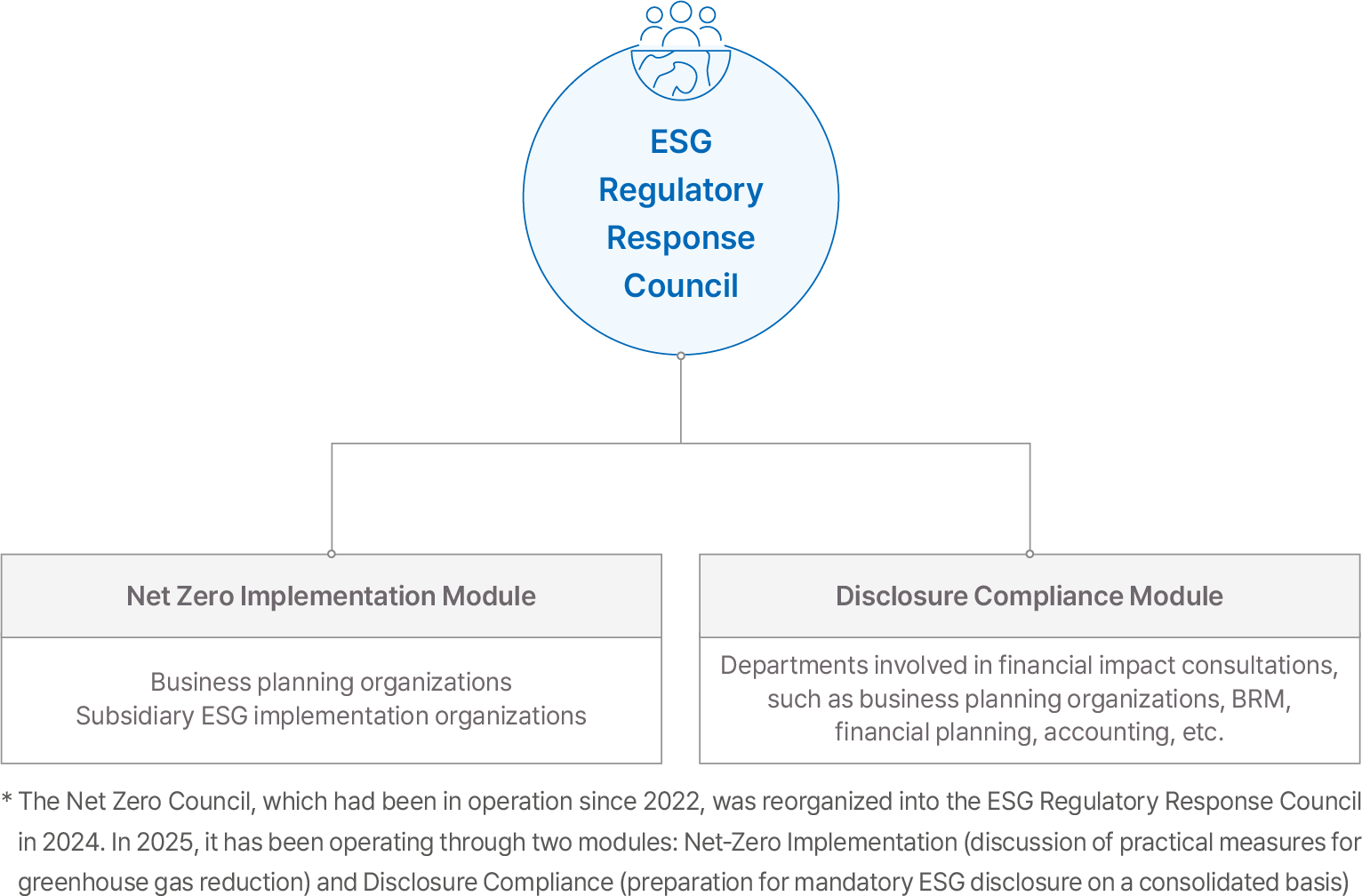
SK ecoplant, spearheaded by its ESG Regulatory Response Council, comprehensively considers not only its major business areas but also the business characteristics of its key consolidated subsidiaries (SK airplus, SK tes, SK oceanplant, etc.), changes in external regulations, and evolving market and stakeholder demands. Based on this analysis, the company identifies direct and indirect risks and opportunities arising from climate change, assesses their materiality, and establishes and implements response strategies. The ESG Regulatory Response Council operates through two modules: Net-Zero Implementation and Disclosure Compliance. A consolidated statutory disclosure system is being established through the operation of a consultative body between SK ecoplant and its subsidiaries to respond to mandatory ESG disclosure requirements on a consolidated basis, the development of greenhouse gas reduction measures for a net-zero strategy, responding to governance structure requirements, monitoring recent ESG regulatory trends, and assessing and improving subsidiaries’ ESG management status.
ESG Regulatory Response Council Organizational Chart
ESG Support Activities
SK ecoplant conducts comprehensive reviews of ESG performance and risks across all subsidiaries and carries out ESG support activities in key areas such as climate change, environment and quality, compliance, and information security. Starting in 2025, the company has been building and managing a consolidated inventory—including subsidiaries—through the ESG Regulatory Response Council’s Net-Zero Implementation and Disclosure Compliance modules.
ESG Support Activities and Performance
Category | Support Activities | Target |
|---|---|---|
ESG |
|
|
Environment & Quality |
|
|
Procurement |
|
|
Compliance |
|
|
Information Security |
|
|
Participation in ESG Initiatives
Initiative Participation Policy
SK ecoplant aims to achieve its carbon emission reduction targets and realize a circular economy by actively participating in domestic and international initiatives and partnerships. The company and its subsidiaries are participating in global initiatives and expanding collaboration with firms and institutions that possess innovative technologies relevant to their respective business models. Through these efforts, SK ecoplant aims to support the strengthening of climate change response capabilities across the industry and contribute to solving global environmental and social issues.
Initiative Participation Activities
Since 2014, SK ecoplant has been disclosing its climate change response strategies and performance through the CDP (Carbon Disclosure Project), and through a Leadership rating (A-) in the 2025 CDP assessment, it received external recognition for its climate change response capabilities. To meet stakeholder demands and enhance the transparency of climate-related information, SK ecoplant joined the Task Force on Climate-related Financial Disclosures (TCFD) Supporters in 2021 and participated in the domestic TCFD Alliance. In 2023, it became the first Korean company in its industry to publish a standalone TCFD report.
Furthermore, in February 2023, SK ecoplant became the first company in its industry to receive Science-Based Targets initiative (SBTi) approval for its emission reduction targets aligned with the 1.5°C scenario. The results of various reduction activities are being monitored based on these targets. As part of these reduction efforts, the company has joined the K-EV100 initiative and set a goal to transition 100% of its fleet to electric and hydrogen vehicles by 2030. In accordance with guidelines from the Ministry of Environment, it has established phased expansion targets of 54.8% by 2027 and 100% by 2030.
SK airplus, a subsidiary, received the “Carbon Management Special Award” at the “2024 Best Companies in Climate Change Response and Water Management” awards ceremony held in April 2025. In the CDP assessment, SK oceanplant, SK tes, and SK airplus all earned a B rating with consulting support from SK ecoplant, thereby gaining recognition for their climate change response systems. SK ecoplant plans to continue supporting major subsidiaries’ participation in climate-related initiatives.
SK ecoplant is striving to strengthen its leadership within the industry by actively participating in various ESG initiatives linked to its business. Moving forward, it will continue to build close cooperative relationships with diverse stakeholders and take the lead in promoting sustainable development across the climate change, environmental, and energy sectors.