
Integrated Risk Management System
Risk Management Governance
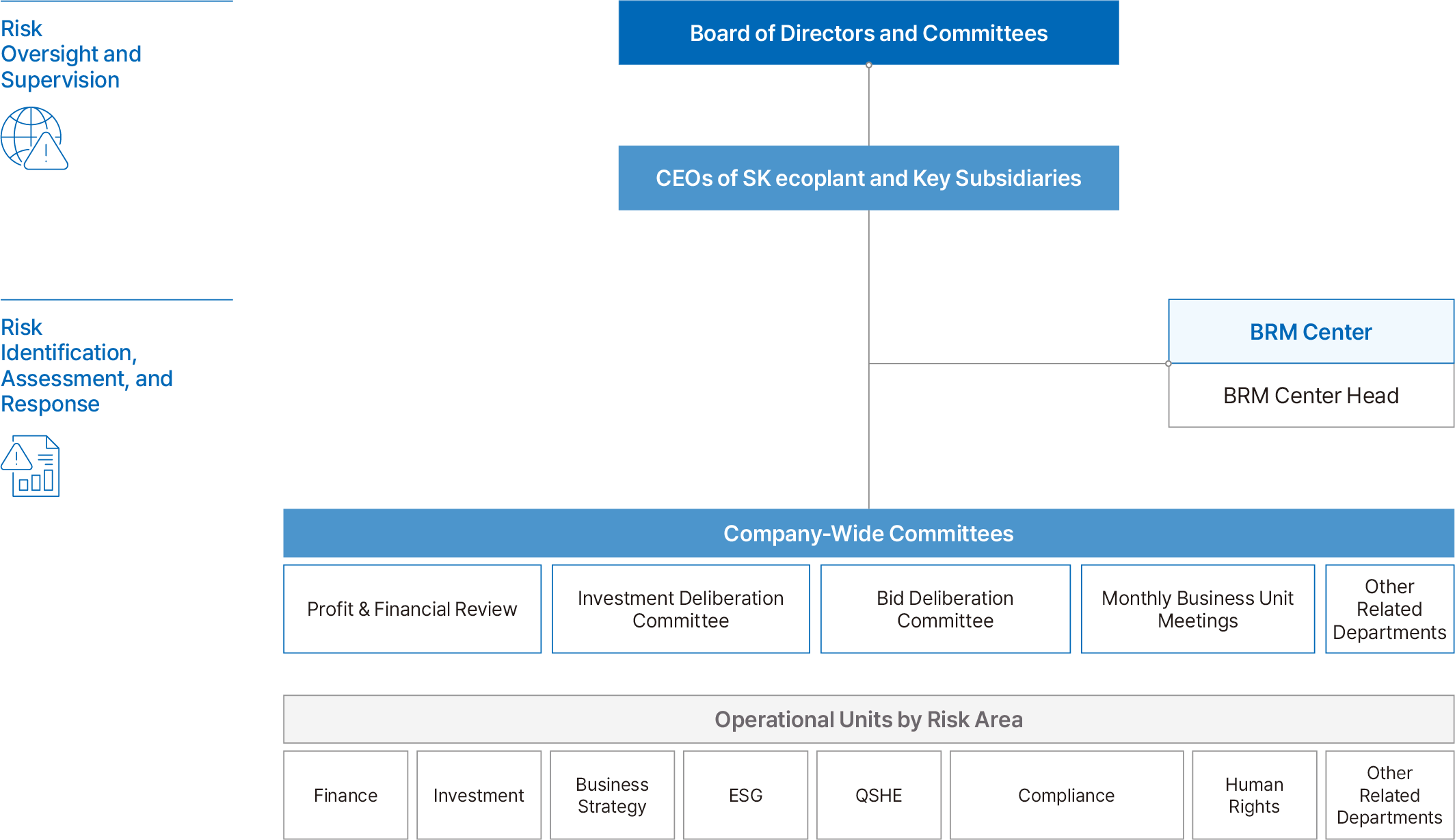
SK ecoplant manages various risks that could affect its overall business operations and management activities in an integrated manner. Key risk areas—including finance, investment, business, strategy, and ESG—are broken down into specific categories, allowing operational units in each field to identify and assess risks that may arise during work. For major issues, response plans and execution strategies are discussed through company-wide committees involving C-level executives and senior management. Key business plans and performance results are regularly reported to the Board and its committees to strengthen the appropriateness of decision-making and accountability in management.
In 2025, SK ecoplant established the Business Risk Management (BRM) Center to prevent risks related to business operations and support swift internal decision-making. The BRM Center also serves as a liaison for external cooperation to address risks not only in the construction industry but also in new business areas such as semiconductors and energy. The Head of the BRM Center, as the person in charge of overseeing the company-wide integrated risk management system, plays a pivotal role in establishing a governance framework to respond swiftly and effectively when risks arise. To this end, the center closely reviews financial and non-financial risks across the entire organization and its business operations, and reports the results of business-related risk management to the Board and its committees. Furthermore, the center continuously enhances the risk management framework for business operations by establishing risk management standards, operating risk identification, assessment, and monitoring processes, and supporting executive reporting as well as decision-making. In addition, the CEOs of SK ecoplant and its key subsidiaries regularly review company-wide risk management strategies and directions while monitoring implementation progress. The Audit Committee independently oversees the appropriateness of company-wide risk management framework operation.
Risk Management Organizational Chart
Risk Management Process
SK ecoplant categorizes risks by area and conducts regular reviews centered on operational units and consultative bodies, operating a systematic, company-wide risk management framework. For financial risks, the CEO presides over profit-and-loss and financial review meetings to continuously monitor financial soundness and operational efficiency. Additionally, the Bid and Investment Deliberation Committees preemptively evaluates potential risk factors arising from new investments and portfolio expansion, incorporating these findings into decision-making.
In addition, key issues in each business division are reviewed through monthly meetings to ensure the efficient allocation of resources and stable business operations even amid a rapidly changing market environment. Furthermore, the company has established separate management systems to comprehensively address ESG risks across the board, including climate change, occupational safety and health, human rights, supply chain, ethics, and compliance.
Management Activities by Risk Type
Category | Risk Type | Risk Management Activities |
|---|---|---|
Business | Determination of Business Participation |
|
Ongoing Risk Management for Active Projects |
| |
Climate Change | Abnormal Climate Risks Such as Heatwaves and Floods, and Emission Trading Costs |
|
Occupational Safety | Occurrence of Occupational Safety and |
|
Human Rights | Violation of Employee Human Rights and |
|
Supply Chain | Unfair Trade Practices and Misconduct with Biz. Partners |
|
Ethics & Compliance | Violation of Laws or Inappropriate Legal |
|
Strategic Risk Management
Risk Management by Business Stage
In line with the transition of its business portfolio toward a focus on semiconductors and AI, SK ecoplant is strengthening its financial stability through operational improvement (O/I) activities, such as enhancing cost efficiency and profitability in its existing businesses. Building on this foundation the company not only establishes a stable business structure, but also utilizes objective analytical metrics and scenario planning to quantitatively assess potential risks, analyze their likelihood and impact, as well as develop and implement response strategies.
Furthermore, by applying the concept of “total risk management,” SK ecoplant proactively identifies and manages risk factors inherent throughout the entire business process, thereby minimizing the influx of new risks and reducing the overall scale of risks. In addition, to enhance the transparency and objectivity of the decision-making process, the company operates a deliberation system centered on open discussion and voting rather than relying on the judgment of specific individuals, thereby promoting rational decision-making regarding business participation.
Marketing Stage
To ensure stable business execution and achieve financial targets, SK ecoplant strives to identify potential risks from the marketing stage and determine whether to proceed with a project and at what scale, based on a comprehensive business feasibility review. Through this process, the company minimizes foreseeable losses and comprehensively evaluates projects’ feasibility and profitability.
Since 2024, SK ecoplant has integrated its project acquisition and investment management systems to enhance management efficiency. To identify and review risks, the company employs checklists tailored to the specific characteristics of each project and product, collaborating closely with relevant departments across various specialized fields. Furthermore, project viability is objectively evaluated based on quantitative indicators such as market conditions, contract terms, and cash flow. The resolvability and acceptable levels of identified risks are carefully assessed by considering various scenarios and their likelihood of occurrence. These findings are ultimately incorporated into the project review stage to support rational and objective decision-making. Externally, even amid ongoing economic uncertainty, SK ecoplant continuously monitors the financial soundness and risk factors of projects in the development stage, improving management processes to enable proactive responses to potential risks and swift decision-making.
Execution Stage
For projects approved for execution, the operating department regularly evaluates whether the project is being carried out properly according to plan from the initial execution phase. By maintaining continuous communication with the project team, the company detects unforeseen risks early and responds swiftly to ensure stable achievement of project goals.
The budget management system is used to review and control the appropriateness of monthly expenditures, while various quantitative, indicator-based analytical tools are employed to monitor potential risks during project execution. Furthermore, key milestones and action plans are established for each major risk to achieve project objectives. In the event of risk occurrence, swift and situationally appropriate response is conducted to prevent escalation. After project completion, a closure reporting process is carried out to identify areas for improvement, and related risks are recorded and managed in connection with the marketing stage to prevent recurrence in future similar projects.
Investment Stage
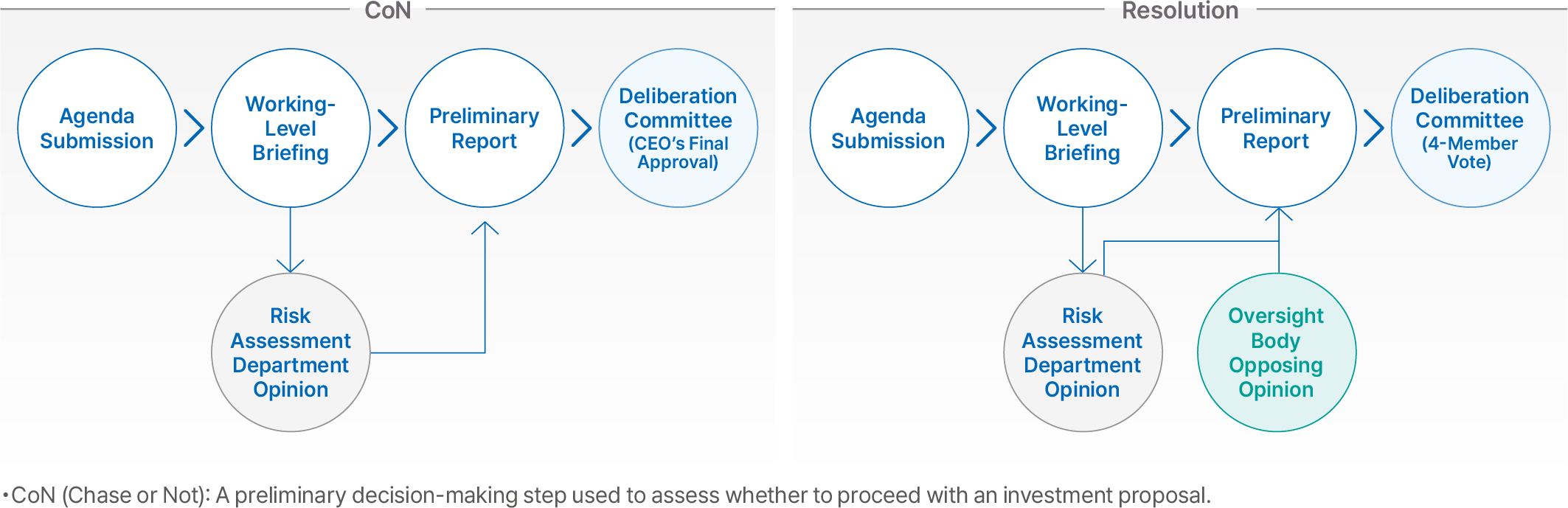
SK ecoplant operates an Investment Deliberation Committee that conducts a comprehensive review of strategic alignment, economic feasibility, and ESG risks when evaluating new investments. Since 2024, a committee centered voting-based decision-making system has been established to ensure that decisions regarding project participation are made based on objective information and identified risks.
The company has also separated preliminary review and final decision-making functions and established an independent oversight body to ensure a more impartial and balanced investment review process. This oversight body consists of experts in relevant fields—such as technology, ESG, and marketing—and conducts a comprehensive review of investment proposals while intentionally presenting opposing views. Final investment decisions are made through a vote that takes into account both the results of the preliminary review and the opposing opinions. Through this, SK ecoplant is establishing an investment decision-making system based on checks and balances, while also developing a reliable risk management framework.
Investment Decision-Making Process
CASE | IT-Based Integrated Risk Management System: Quality Gate |
|---|
SK ecoplant operates a Quality Gate system to segment the entire project execution process into distinct phases and manage issues and potential risks in an integrated manner. Through this system, phase-specific risks are identified in advance and business feasibility is verified to support final decision-makers in determining whether to proceed with project participation.

CASE | IT System for Preemptive Risk Identification: e-PM |
|---|
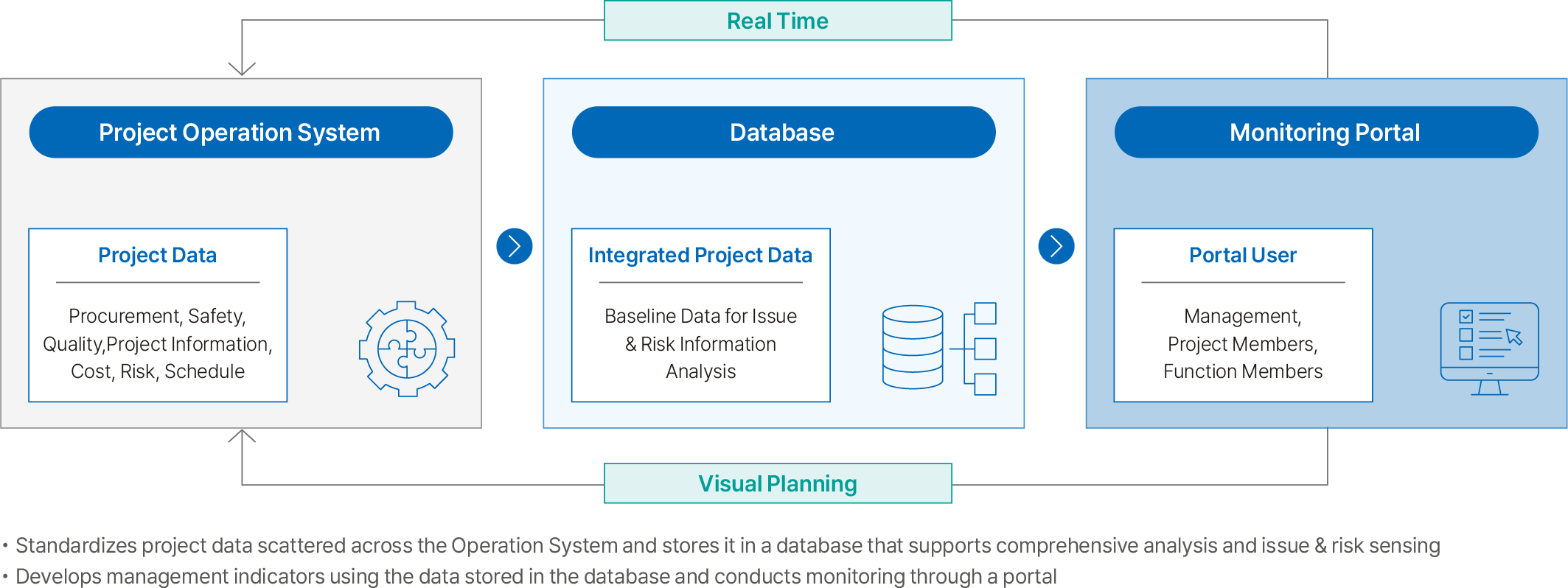
SK ecoplant preemptively monitors project risks using e-PM, an IT system designed for early risk identification. e-PM standardizes project data dispersed across the project operation system and stores it in a database. Based on this data, it develops and visualizes management indicators to enable integrated management of issues and risks.
Subsidiary Risk Management
SK ecoplant has reorganized its Net Zero Council into the ESG Regulatory Response Council to promote ESG zero risk initiatives across its subsidiaries. Centered on two modules—“Net Zero Implementation” and “Disclosure Compliance”—the ESG Regulatory Response Council comprehensively considers not only the business characteristics of each subsidiary but also changes in external regulations, market conditions, and stakeholder demands. Based on this, the council identifies direct and indirect risks and opportunities arising from climate change, establishes response strategies following a materiality assessment, and implements them.
ESG Potential Risk Management
SK ecoplant proactively identifies and manages ESG risks to minimize uncertainty in the business environment. Through continuous monitoring, the company tracks changes in the domestic and international ESG regulatory landscape, establishes improvement goals and response strategies for compliance, and implements systematic management activities. This approach helps mitigate the negative impacts of potential ESG risks and supports the leveraging of opportunities based on strategic decision-making. Key ESG risks, opportunities, and response strategies are disclosed in this report in conjunction with materiality assessment results.